
Textbook Question
Find the values of the six trigonometric functions for an angle in standard position having each given point on its terminal side. Rationalize denominators when applicable. (―8 , 15)
766
views

 Verified step by step guidance
 3:35
3:35
 7:48
7:48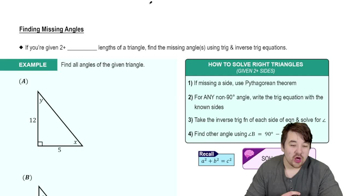 5:13
5:13Find the values of the six trigonometric functions for an angle in standard position having each given point on its terminal side. Rationalize denominators when applicable. (―8 , 15)
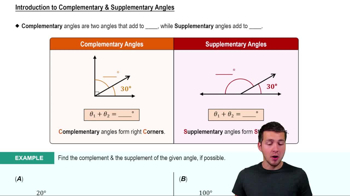
Find the measure of each marked angle. See Example 2 complementary angles with measures 9𝓍 + 6 and 3𝓍 degrees
Sketch an angle θ in standard position such that θ has the least positive measure, and the given point is on the terminal side of θ. Then find the values of the six trigonometric functions for each angle. Rationalize denominators when applicable. See Examples 1, 2, and 4. (―2√3 , 2)
Find the measure of each marked angle. See Example 2 supplementary angles with measures 10𝓍 + 7 and 7𝓍 + 3 degrees
The measures of two angles of a triangle are given. Find the measure of the third angle. See Example 2.
17° 41' 13" , 96° 12' 10"
Determine the signs of the trigonometric functions of an angle in standard position with the given measure. See Example 2.
178°