Write each expression as a sum or difference of trigonometric functions. See Example 7. 2 cos 85° sin 140°
Verified step by step guidance
1
Recall the product-to-sum identities, which help express products of sine and cosine functions as sums or differences. The relevant identity here is: \[2 \cos A \sin B = \sin(A + B) - \sin(A - B)\].
Identify the angles in the expression: here, \[A = 85^\circ\] and \[B = 140^\circ\].
Apply the identity by substituting the values of \[A\] and \[B\] into the formula: \[2 \cos 85^\circ \sin 140^\circ = \sin(85^\circ + 140^\circ) - \sin(85^\circ - 140^\circ)\].
Simplify the angles inside the sine functions: calculate \[85^\circ + 140^\circ\] and \[85^\circ - 140^\circ\] to get the new angles for the sine terms.
Write the final expression as a difference of sine functions with the simplified angles: \[\sin(225^\circ) - \sin(-55^\circ)\].
Verified video answer for a similar problem:
This video solution was recommended by our tutors as helpful for the problem above
Play a video:
0 Comments
Key Concepts
Here are the essential concepts you must grasp in order to answer the question correctly.
Product-to-Sum Formulas
Product-to-sum formulas convert products of sine and cosine functions into sums or differences of trigonometric functions. For example, the formula 2 cos A sin B = sin(A + B) - sin(A - B) helps rewrite expressions like 2 cos 85° sin 140° as a difference of sines.
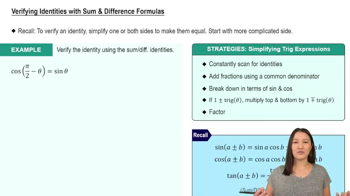
Verifying Identities with Sum and Difference Formulas
Trigonometric Function Properties
Understanding the basic properties and values of sine and cosine functions, including their behavior with angle addition and subtraction, is essential. This knowledge allows for correct application of formulas and simplification of expressions involving angles.
Trigonometric calculations often use degrees or radians; here, degrees are used. Being comfortable converting and working with degrees ensures accurate substitution into formulas and correct evaluation of trigonometric expressions.