Ch. R - Algebra Review
Lial - Trigonometry 12th Edition
Lial12th EditionTrigonometryISBN: 9780136552161Not the one you use?Change textbook
Chapter 1, Problem 8

CONCEPT PREVIEW Evaluate each expression. 2 • 5 - 10 ÷ 2

Verified step by step guidance
1
Identify the order of operations to evaluate the expression correctly. Remember the acronym PEMDAS (Parentheses, Exponents, Multiplication and Division (from left to right), Addition and Subtraction (from left to right)).
Rewrite the expression: \(2 \cdot 5 - 10 \div 2\).
First, perform the multiplication and division from left to right. Calculate \(2 \cdot 5\) and \(10 \div 2\) separately.
After finding the results of the multiplication and division, substitute them back into the expression to get a simpler expression involving only subtraction.
Finally, perform the subtraction to complete the evaluation of the expression.

Verified video answer for a similar problem:

This video solution was recommended by our tutors as helpful for the problem above.
Video duration:
2m
Was this helpful?

Key Concepts

Here are the essential concepts you must grasp in order to answer the question correctly.

Order of Operations

The order of operations is a set of rules that dictate the sequence in which mathematical operations should be performed to ensure consistent results. The common acronym PEMDAS (Parentheses, Exponents, Multiplication and Division, Addition and Subtraction) helps remember this order. Multiplication and division are performed from left to right before addition and subtraction.
Recommended video:
04:12
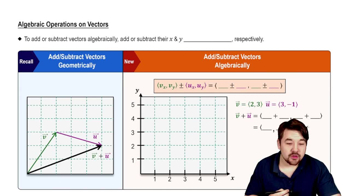
Algebraic Operations on Vectors

Multiplication and Division

Multiplication and division are inverse operations that are performed at the same priority level in the order of operations. When both appear in an expression, they are evaluated from left to right. For example, in the expression 2 • 5 - 10 ÷ 2, multiplication and division must be handled before subtraction.
Recommended video:
03:05
Powers Of Complex Numbers In Polar Form (DeMoivre's Theorem) Example 1

Subtraction

Subtraction is the operation of finding the difference between numbers and is performed after multiplication and division in the order of operations. Once all multiplication and division are completed, subtraction is applied from left to right to simplify the expression fully.
Recommended video:
3:18
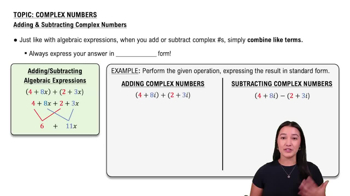
Adding and Subtracting Complex Numbers