Ch. 1 - Trigonometric Functions
Lial - Trigonometry 12th Edition
Lial12th EditionTrigonometryISBN: 9780136552161Not the one you use?Change textbook
Chapter 2, Problem 5

CONCEPT PREVIEW In each figure, find the measures of the numbered angles, given that lines m and n are parallel.

Verified step by step guidance
1
Identify the given angles and the numbered angles in the figure, noting that lines \( m \) and \( n \) are parallel.
Recall that when two lines are parallel, corresponding angles are equal, alternate interior angles are equal, and consecutive interior angles are supplementary (sum to 180 degrees).
Use the properties of parallel lines to set up equations relating the given angles to the numbered angles. For example, if an angle is corresponding to a numbered angle, set them equal: \( \text{angle}_1 = \text{angle}_2 \).
If the angles are consecutive interior angles, use the supplementary angle relationship: \( \text{angle}_1 + \text{angle}_2 = 180^\circ \).
Solve the resulting equations step-by-step to find the measures of the numbered angles.

Verified video answer for a similar problem:

This video solution was recommended by our tutors as helpful for the problem above.
Was this helpful?

Key Concepts

Here are the essential concepts you must grasp in order to answer the question correctly.

Parallel Lines and Transversals

When two lines are parallel, a transversal crossing them creates specific angle relationships. Understanding how angles correspond, alternate interior, and alternate exterior angles relate is essential to find unknown angle measures.
Recommended video:
1:30
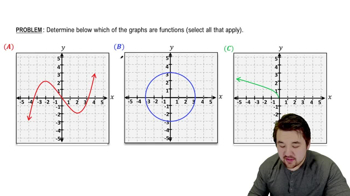
Example 1

Angle Relationships

Key angle pairs such as corresponding angles, alternate interior angles, and consecutive interior angles have equal or supplementary measures when lines are parallel. Recognizing these relationships helps determine unknown angles.
Recommended video:
04:46
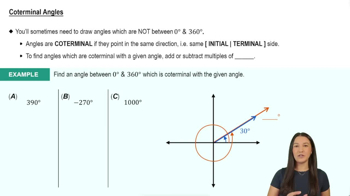
Coterminal Angles

Properties of Supplementary and Complementary Angles

Angles on a straight line sum to 180° (supplementary), and angles forming a right angle sum to 90° (complementary). These properties are used alongside parallel line theorems to calculate missing angle measures.
Recommended video:
3:35
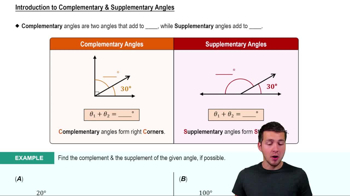
Intro to Complementary & Supplementary Angles