Ch. 4 - Laws of Sines and Cosines; Vectors
Blitzer - Trigonometry 3rd Edition
Blitzer3rd EditionTrigonometryISBN: 9780137316601Not the one you use?Change textbook
Chapter 4, Problem 19

In Exercises 9–24, solve each triangle. Round lengths to the nearest tenth and angle measures to the nearest degree.a = 3, b = 9, c = 8

Verified step by step guidance
1
insert step 1: Identify the type of triangle using the given side lengths a = 3, b = 9, and c = 8.
insert step 2: Use the Law of Cosines to find one of the angles. For example, to find angle C, use the formula: \( c^2 = a^2 + b^2 - 2ab \cdot \cos(C) \).
insert step 3: Solve the equation from step 2 for \( \cos(C) \) and then use the inverse cosine function to find angle C.
insert step 4: Use the Law of Sines to find another angle. For example, use \( \frac{a}{\sin(A)} = \frac{b}{\sin(B)} = \frac{c}{\sin(C)} \) to find angle A or B.
insert step 5: Use the fact that the sum of angles in a triangle is 180 degrees to find the remaining angle.

Verified video answer for a similar problem:

This video solution was recommended by our tutors as helpful for the problem above.
Video duration:
8m
Was this helpful?

Key Concepts

Here are the essential concepts you must grasp in order to answer the question correctly.

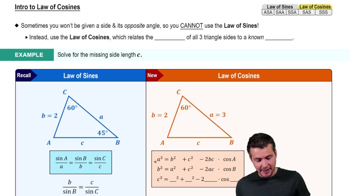
Law of Cosines

The Law of Cosines is a fundamental formula used in trigonometry to relate the lengths of the sides of a triangle to the cosine of one of its angles. It states that for any triangle with sides a, b, and c opposite to angles A, B, and C respectively, the formula is c² = a² + b² - 2ab * cos(C). This law is particularly useful for solving triangles when two sides and the included angle are known or when all three sides are known.
Recommended video:
4:35
Intro to Law of Cosines

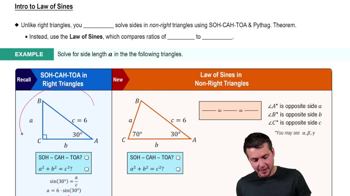
Law of Sines

The Law of Sines is another essential theorem in trigonometry that relates the ratios of the lengths of sides of a triangle to the sines of its angles. It states that (a/sin(A)) = (b/sin(B)) = (c/sin(C)). This law is particularly useful for solving triangles when two angles and one side are known or when two sides and a non-included angle are known, allowing for the determination of unknown angles and sides.
Recommended video:
4:27
Intro to Law of Sines

Triangle Classification

Triangles can be classified based on their sides and angles, which is crucial for applying the appropriate trigonometric laws. The main classifications are scalene (no equal sides), isosceles (two equal sides), and equilateral (all sides equal). Additionally, triangles can be classified by angles as acute (all angles less than 90°), right (one angle is 90°), or obtuse (one angle greater than 90°). Understanding these classifications helps in selecting the right methods for solving the triangle.
Recommended video:
5:35
30-60-90 Triangles