Solve each equation for exact solutions. 2 arccos (x/3 - π/3) = 2π
Verified step by step guidance
1
Start by isolating the arccosine expression. Given the equation \(2 \arccos\left(\frac{x}{3} - \frac{\pi}{3}\right) = 2\pi\), divide both sides by 2 to get \(\arccos\left(\frac{x}{3} - \frac{\pi}{3}\right) = \pi\).
Recall the definition and range of the arccosine function: \(\arccos(y)\) returns an angle \(\theta\) such that \(\cos(\theta) = y\) and \(\theta \in [0, \pi]\). Here, \(\arccos\left(\frac{x}{3} - \frac{\pi}{3}\right) = \pi\) means the angle whose cosine is \(\frac{x}{3} - \frac{\pi}{3}\) is \(\pi\).
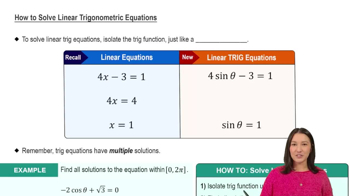
Use the property of cosine: \(\cos(\pi) = -1\). Set the inside of the arccos equal to \(\cos(\pi)\), so \(\frac{x}{3} - \frac{\pi}{3} = -1\).
Solve the resulting linear equation for \(x\): multiply both sides by 3 to clear the denominator, then isolate \(x\).
Check the solution to ensure it lies within the domain of the arccos function, which requires the argument \(\frac{x}{3} - \frac{\pi}{3}\) to be in the interval \([-1, 1]\).
Verified video answer for a similar problem:
This video solution was recommended by our tutors as helpful for the problem above
Play a video:
0 Comments
Key Concepts
Here are the essential concepts you must grasp in order to answer the question correctly.
Inverse Trigonometric Functions (Arccos)
The arccos function is the inverse of the cosine function, returning the angle whose cosine is a given number. Its principal range is from 0 to π radians. Understanding arccos helps in solving equations where the angle is expressed as arccos of an expression.
Solving trigonometric equations involves isolating the trigonometric function and finding all angles that satisfy the equation within the function's domain. This often requires using inverse functions and considering the periodicity of trigonometric functions to find all solutions.
When dealing with inverse trig functions, it is crucial to consider the domain of the original function and the range of the inverse function. For arccos, the input must be between -1 and 1, and the output angle lies between 0 and π, which restricts possible solutions.

 Verified step by step guidance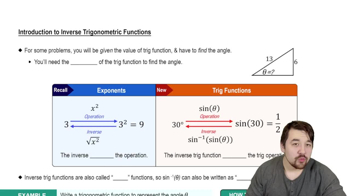
 4:28
4:28