Ch. 3 - Radian Measure and The Unit Circle
Lial - Trigonometry 12th Edition
Lial12th EditionTrigonometryISBN: 9780136552161Not the one you use?Change textbook
Chapter 4, Problem 92

Through how many radians does the minute hand on a clock rotate in (a) 12 hr and (b) 3 hr?

Verified step by step guidance
1
Recall that the minute hand completes one full rotation every 60 minutes, which corresponds to 360 degrees or \(2\pi\) radians.
Calculate the number of full rotations the minute hand makes in the given time by converting hours to minutes and dividing by 60 minutes per rotation.
For part (a), convert 12 hours to minutes: \(12 \times 60 = 720\) minutes. Then find the number of rotations: \(\frac{720}{60} = 12\) rotations.
Multiply the number of rotations by the radians per rotation to find the total radians rotated: \(12 \times 2\pi\) radians.
For part (b), repeat the process for 3 hours: convert to minutes \(3 \times 60 = 180\) minutes, find rotations \(\frac{180}{60} = 3\), then multiply by \(2\pi\) radians to get the total radians rotated.

Verified video answer for a similar problem:

This video solution was recommended by our tutors as helpful for the problem above.
Was this helpful?

Key Concepts

Here are the essential concepts you must grasp in order to answer the question correctly.

Radian Measure of Angles

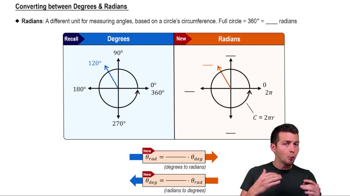
A radian is a unit of angular measure based on the radius of a circle. One radian is the angle subtended at the center of a circle by an arc equal in length to the radius. There are 2π radians in a full circle (360 degrees), which is essential for converting rotations into radians.
Recommended video:
5:04
Converting between Degrees & Radians

Angular Velocity of the Minute Hand

The minute hand completes one full rotation (360 degrees or 2π radians) every 60 minutes. Understanding this constant angular velocity allows calculation of the total radians rotated over any given time by multiplying the number of rotations by 2π.
Recommended video:
5:08
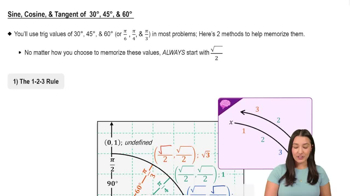
Sine, Cosine, & Tangent of 30°, 45°, & 60°

Time to Angle Conversion

To find the angle rotated over a period, convert the given time into the number of full rotations of the minute hand. Multiplying the number of rotations by 2π radians gives the total radians rotated, linking time intervals directly to angular displacement.
Recommended video:
04:46
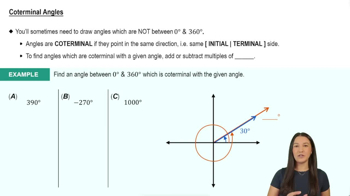
Coterminal Angles