Ch. 6 - Inverse Circular Functions and Trigonometric Equations
Lial - Trigonometry 12th Edition
Lial12th EditionTrigonometryISBN: 9780136552161Not the one you use?Change textbook
Chapter 7, Problem 29

Solve each equation for exact solutions.
6 sin⁻¹ x = 5π

Verified step by step guidance
1
Start with the given equation: \(6 \sin^{-1} x = 5\pi\).
Isolate the inverse sine function by dividing both sides of the equation by 6: \(\sin^{-1} x = \frac{5\pi}{6}\).
Recall that \(\sin^{-1} x\) (also called arcsin) gives the angle whose sine is \(x\), and its principal value range is \([-\frac{\pi}{2}, \frac{\pi}{2}]\).
Check if \(\frac{5\pi}{6}\) lies within the principal range of \(\sin^{-1} x\). Since \(\frac{5\pi}{6}\) is greater than \(\frac{\pi}{2}\), it is outside the principal range, so consider the periodicity and properties of sine to find all possible solutions.
Use the sine function to write \(x = \sin\left( \frac{5\pi}{6} \right)\) and then find all \(x\) values that satisfy this equation within the domain of \(\sin^{-1} x\), considering the sine function's symmetry and periodicity.

Verified video answer for a similar problem:

This video solution was recommended by our tutors as helpful for the problem above.
Was this helpful?

Key Concepts

Here are the essential concepts you must grasp in order to answer the question correctly.

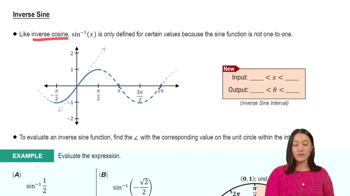
Inverse Sine Function (sin⁻¹ or arcsin)

The inverse sine function, sin⁻¹(x), returns the angle whose sine is x. Its output range is limited to [-π/2, π/2], meaning it only gives principal values within this interval. Understanding this range is crucial when solving equations involving sin⁻¹.
Recommended video:
4:03
Inverse Sine

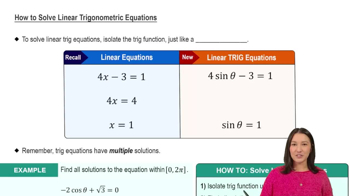
Solving Trigonometric Equations

Solving trigonometric equations involves isolating the trigonometric function and then finding all possible angles that satisfy the equation within the given domain. For inverse functions, solutions must respect the function's principal range or be adjusted accordingly.
Recommended video:
4:34
How to Solve Linear Trigonometric Equations

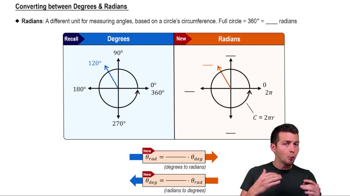
Exact Values and Radian Measure

Exact solutions in trigonometry are expressed in terms of π or known special angles rather than decimal approximations. Radian measure is the standard unit for angles in higher mathematics, where π radians equal 180 degrees, facilitating precise and exact answers.
Recommended video:
5:04
Converting between Degrees & Radians