Ch. 3 - Trigonometric Identities and Equations
Blitzer - Trigonometry 3rd Edition
Blitzer3rd EditionTrigonometryISBN: 9780137316601Not the one you use?Change textbook
Chapter 3, Problem 3.3.37

In Exercises 35–38, use the power-reducing formulas to rewrite each expression as an equivalent expression that does not contain powers of trigonometric functions greater than 1. sin² x cos² x

Verified step by step guidance
1
Recall the power-reducing formulas for sine squared and cosine squared: \(\sin^{2}x = \frac{1 - \cos(2x)}{2}\) and \(\cos^{2}x = \frac{1 + \cos(2x)}{2}\).
Rewrite the expression \(\sin^{2}x \cos^{2}x\) by substituting the power-reducing formulas: \(\sin^{2}x \cos^{2}x = \left(\frac{1 - \cos(2x)}{2}\right) \times \left(\frac{1 + \cos(2x)}{2}\right)\).
Multiply the two fractions: \(\sin^{2}x \cos^{2}x = \frac{(1 - \cos(2x))(1 + \cos(2x))}{4}\).
Recognize that \((1 - \cos(2x))(1 + \cos(2x))\) is a difference of squares: \(1 - \cos^{2}(2x)\).
Use the Pythagorean identity \(\sin^{2}\theta = 1 - \cos^{2}\theta\) to rewrite the expression as: \(\sin^{2}x \cos^{2}x = \frac{\sin^{2}(2x)}{4}\).

Verified video answer for a similar problem:

This video solution was recommended by our tutors as helpful for the problem above.
Video duration:
2m
Was this helpful?

Key Concepts

Here are the essential concepts you must grasp in order to answer the question correctly.

Power-Reducing Formulas

Power-reducing formulas express powers of sine and cosine functions in terms of first powers of trigonometric functions with multiple angles. For example, sin²x can be rewritten as (1 - cos 2x)/2. These formulas simplify expressions by reducing the exponent, making integration and other operations easier.
Recommended video:
03:41
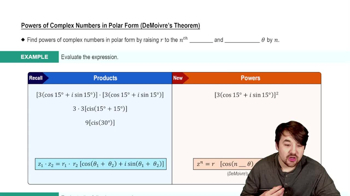
Powers Of Complex Numbers In Polar Form (DeMoivre's Theorem)

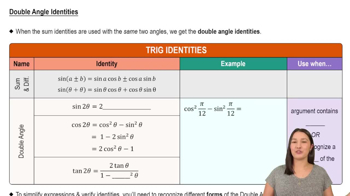
Double-Angle Identities

Double-angle identities relate trigonometric functions of double angles to functions of single angles, such as cos 2x = cos²x - sin²x. These identities are essential for applying power-reducing formulas because they allow rewriting powers of sine and cosine in terms of cos 2x or sin 2x.
Recommended video:
05:06
Double Angle Identities

Product-to-Sum Formulas

Product-to-sum formulas convert products of sine and cosine functions into sums or differences of trigonometric functions. For example, sin A cos B = (1/2)[sin(A+B) + sin(A-B)]. These formulas help simplify expressions like sin²x cos²x by breaking down products into sums, facilitating further reduction.
Recommended video:
2:25
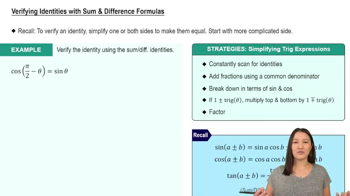
Verifying Identities with Sum and Difference Formulas