Textbook Question
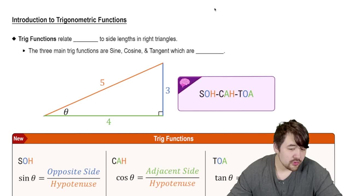
In Exercises 63–82, use a sketch to find the exact value of each expression. cot (csc⁻¹ 8)
688
views

 Blitzer 3rd EditionCh. 2 - Graphs of the Trigonometric Functions; Inverse Trigonometric FunctionsProblem 82
 Verified step by step guidance
 6:04
6:04
 3:18
3:18 5:33
5:33In Exercises 63–82, use a sketch to find the exact value of each expression. cot (csc⁻¹ 8)
In Exercises 63–82, use a sketch to find the exact value of each expression. cos [tan⁻¹ (− 2/3)]
In Exercises 79–82, graph f, g, and h in the same rectangular coordinate system for 0 ≤ x ≤ 2π. Obtain the graph of h by adding or subtracting the corresponding y-coordinates on the graphs of f and g. f(x) = 2 cos x, g(x) = cos 2x, h(x) = (f + g)(x)
In Exercises 83–94, use a right triangle to write each expression as an algebraic expression. Assume that x is positive and that the given inverse trigonometric function is defined for the expression in x. sin (tan⁻¹ x)
In Exercises 83–94, use a right triangle to write each expression as an algebraic expression. Assume that x is positive and that the given inverse trigonometric function is defined for the expression in x. cos (sin⁻¹ 1/x)
In Exercises 83–94, use a right triangle to write each expression as an algebraic expression. Assume that x is positive and that the given inverse trigonometric function is defined for the expression in x. tan (cos⁻¹ x)