Identify the given sides of the triangle: \(a = 9.3\) cm, \(b = 5.7\) cm, and \(c = 8.2\) cm. Since all three sides are known, this is a side-side-side (SSS) triangle problem.
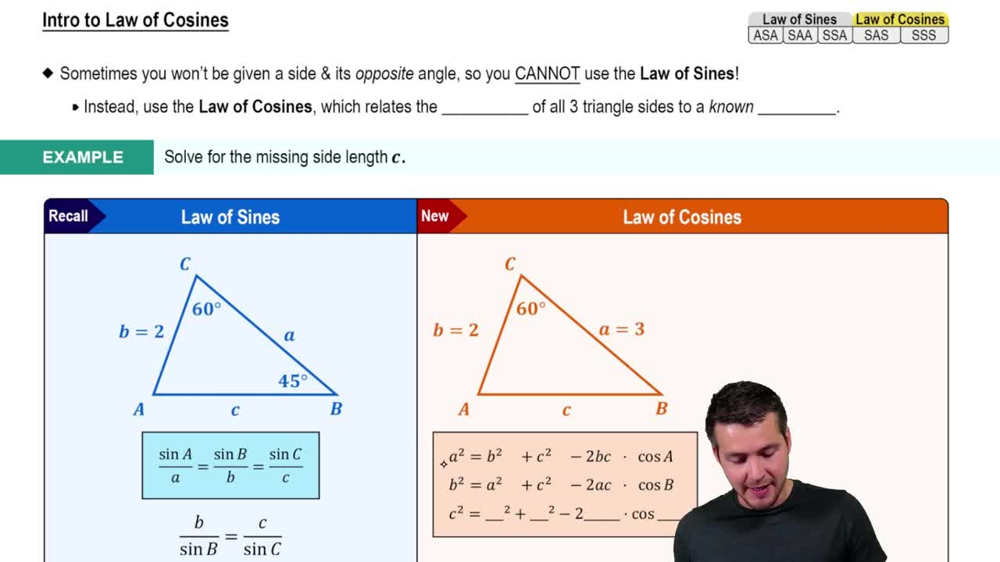
Use the Law of Cosines to find one of the angles. For example, to find angle \(A\) opposite side \(a\), use the formula: \[\cos A = \frac{b^2 + c^2 - a^2}{2bc}\]
Calculate \(\cos A\) by substituting the known side lengths into the formula, then find angle \(A\) by taking the inverse cosine (arccos) of that value: \[A = \cos^{-1}\left(\frac{b^2 + c^2 - a^2}{2bc}\right)\]
Repeat the Law of Cosines process to find another angle, such as angle \(B\) opposite side \(b\), using: \[\cos B = \frac{a^2 + c^2 - b^2}{2ac}\] and then \[B = \cos^{-1}\left(\frac{a^2 + c^2 - b^2}{2ac}\right)\]
Find the third angle \(C\) by using the fact that the sum of angles in a triangle is \(180^\circ\): \[C = 180^\circ - A - B\]
Verified video answer for a similar problem:
This video solution was recommended by our tutors as helpful for the problem above
Play a video:
0 Comments
Key Concepts
Here are the essential concepts you must grasp in order to answer the question correctly.
Triangle Classification and Properties
Understanding the types of triangles (scalene, isosceles, equilateral) and their properties helps in identifying the approach to solve the triangle. Given three sides, the triangle is scalene if all sides differ, which affects the methods used to find angles and other elements.
The Law of Cosines relates the lengths of the sides of a triangle to the cosine of one of its angles. It is essential for finding unknown angles when all three sides are known, using the formula c² = a² + b² - 2ab cos(C), allowing calculation of each angle from the given sides.
Solving a triangle means finding all unknown sides and angles. When all three sides are given, the Law of Cosines is used to find angles, followed by the Law of Sines if needed. This systematic approach ensures complete determination of the triangle's dimensions.

 Verified step by step guidance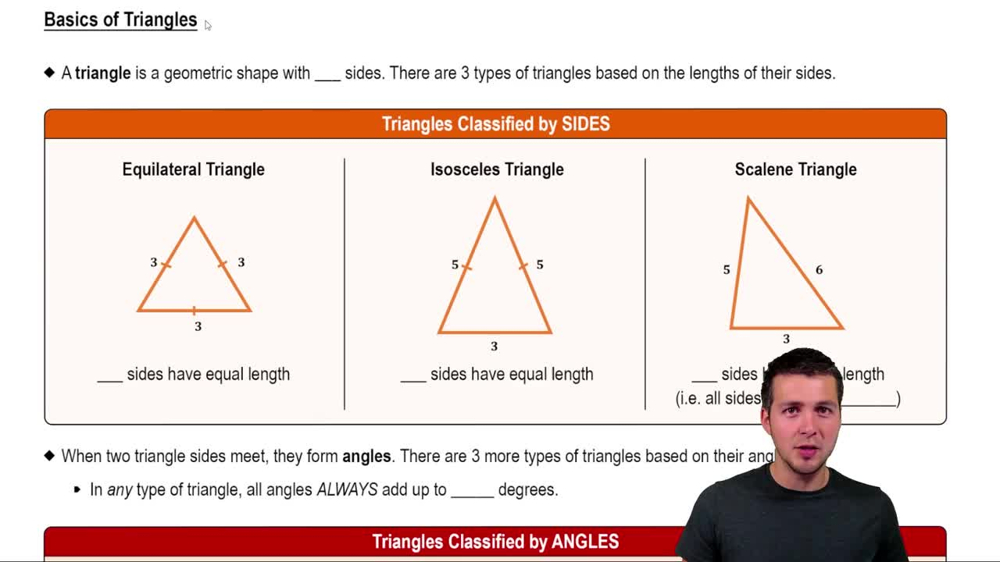
 4:42
4:42