Ch. 6 - Inverse Circular Functions and Trigonometric Equations
Lial - Trigonometry 12th Edition
Lial12th EditionTrigonometryISBN: 9780136552161Not the one you use?Change textbook
Chapter 7, Problem 17

Use a calculator to approximate each value in decimal degrees.
θ = arctan 1.7804675

Verified step by step guidance
1
Recognize that the problem asks for the angle \( \theta \) such that \( \tan(\theta) = 1.7804675 \). This means \( \theta = \arctan(1.7804675) \).
Recall that the arctangent function, \( \arctan(x) \), gives the angle whose tangent is \( x \), and the result is typically in radians or degrees depending on the calculator settings.
Set your calculator to degree mode since the problem asks for the angle in decimal degrees.
Use the calculator's arctangent function (often labeled as \( \tan^{-1} \) or \( \arctan \)) and input the value \( 1.7804675 \) to find \( \theta \).
The calculator will provide the approximate value of \( \theta \) in decimal degrees, which is the solution to the problem.

Verified video answer for a similar problem:

This video solution was recommended by our tutors as helpful for the problem above.
Was this helpful?

Key Concepts

Here are the essential concepts you must grasp in order to answer the question correctly.

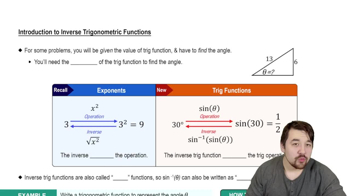
Inverse Trigonometric Functions

Inverse trigonometric functions, such as arctan, are used to find the angle whose trigonometric ratio equals a given value. For arctan, it returns the angle whose tangent is the input number, typically in radians or degrees.
Recommended video:
4:28
Introduction to Inverse Trig Functions

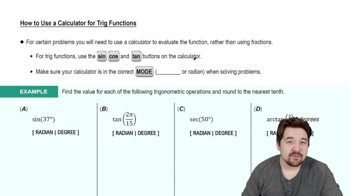
Using a Calculator for Trigonometric Values

Calculators can compute inverse trigonometric functions directly, often requiring the mode to be set to degrees or radians. For arctan, input the value and use the arctan or tan⁻¹ function to find the angle.
Recommended video:
4:45
How to Use a Calculator for Trig Functions

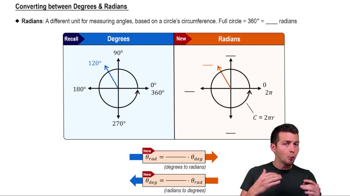
Decimal Degrees

Decimal degrees express angles as a decimal number rather than degrees, minutes, and seconds. This format is useful for precise calculations and is commonly used in scientific and engineering contexts.
Recommended video:
5:04
Converting between Degrees & Radians