Ch. 1 - Angles and the Trigonometric Functions
Blitzer - Trigonometry 3rd Edition
Blitzer3rd EditionTrigonometryISBN: 9780137316601Not the one you use?Change textbook
Chapter 1, Problem 1.19a

Use the unit circle shown to find the value of the trigonometric function.
cos πœ‹/6

Verified step by step guidance
1
Identify the angle \( \frac{\pi}{6} \) on the unit circle. This angle corresponds to 30 degrees.
Recall that the unit circle is a circle with a radius of 1 centered at the origin of the coordinate plane.
On the unit circle, the coordinates of a point corresponding to an angle \( \theta \) are \((\cos \theta, \sin \theta)\).
For \( \theta = \frac{\pi}{6} \), find the x-coordinate of the point on the unit circle, which represents \( \cos \frac{\pi}{6} \).
Use the known values from the unit circle: \( \cos \frac{\pi}{6} = \frac{\sqrt{3}}{2} \).

Verified video answer for a similar problem:

This video solution was recommended by our tutors as helpful for the problem above.
Video duration:
1m
Was this helpful?

Key Concepts

Here are the essential concepts you must grasp in order to answer the question correctly.

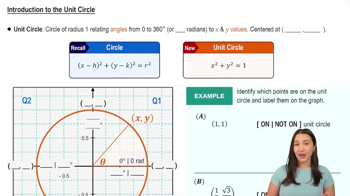
Unit Circle

The unit circle is a circle with a radius of one centered at the origin of a coordinate plane. It is a fundamental tool in trigonometry, as it allows for the definition of trigonometric functions based on the coordinates of points on the circle. The x-coordinate of a point on the unit circle corresponds to the cosine of the angle, while the y-coordinate corresponds to the sine.
Recommended video:
06:11
Introduction to the Unit Circle

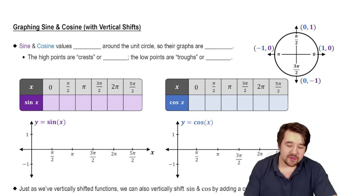
Cosine Function

The cosine function, denoted as cos(ΞΈ), represents the x-coordinate of a point on the unit circle corresponding to an angle ΞΈ measured from the positive x-axis. For angles measured in radians, such as Ο€/6, the cosine function provides a specific value that can be derived from the coordinates of the corresponding point on the unit circle.
Recommended video:
5:53
Graph of Sine and Cosine Function

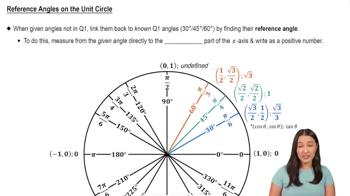
Reference Angles

Reference angles are the acute angles formed by the terminal side of an angle and the x-axis. They are crucial for determining the values of trigonometric functions in different quadrants. For example, the angle Ο€/6 has a reference angle of Ο€/6 itself, which helps in finding its cosine value directly from the unit circle.
Recommended video:
5:31
Reference Angles on the Unit Circle