
Textbook Question
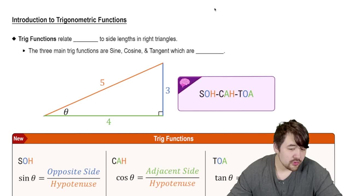
In Exercises 9–16, use the given triangles to evaluate each expression. If necessary, express the value without a square root in the denominator by rationalizing the denominator.
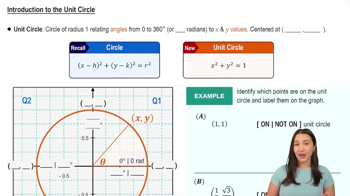
sin 𝜋/4 - cos 𝜋/4
636
views


 Verified step by step guidance
 06:11
06:11
 6:04
6:04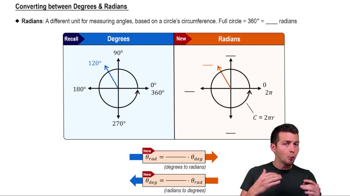 5:04
5:04In Exercises 9–16, use the given triangles to evaluate each expression. If necessary, express the value without a square root in the denominator by rationalizing the denominator.
sin 𝜋/4 - cos 𝜋/4
In Exercises 5–18, the unit circle has been divided into twelve equal arcs, corresponding to t-values of
0, 𝜋, 𝜋, 𝜋, 2𝜋, 5𝜋, 𝜋, 7𝜋, 4𝜋, 3𝜋, 5𝜋, 11𝜋, and 2𝜋.
6 3 2 3 6 6 3 2 3 6
Use the (x,y) coordinates in the figure to find the value of each trigonometric function at the indicated real number, t, or state that the expression is undefined.
<IMAGE>
In Exercises 11–18, continue to refer to the figure at the bottom of the previous page.
sec 11𝜋/6
In Exercises 13–17, find a positive angle less than 360° or 2𝜋 that is coterminal with the given angle. -445°
Use the given triangles to evaluate each expression. If necessary, express the value without a square root in the denominator by rationalizing the denominator.
<IMAGE>
tan 𝜋/3
In Exercises 5–18, the unit circle has been divided into twelve equal arcs, corresponding to t-values of 0, 𝜋, 𝜋, 𝜋, 2𝜋, 5𝜋, 𝜋, 7𝜋, 4𝜋, 3𝜋, 5𝜋, 11𝜋, and 2𝜋. 6 3 2 3 6 6 3 2 3 6 Use the (x,y) coordinates in the figure to find the value of each trigonometric function at the indicated real number, t, or state that the expression is undefined.
In Exercises 11–18, continue to refer to the figure at the bottom of the previous page. csc 4𝜋/3
The unit circle has been divided into twelve equal arcs, corresponding to t-values of
0, 𝜋/6, 𝜋/3, 𝜋/2, 2𝜋/3, 5𝜋/6, 𝜋, 7𝜋/6, 4𝜋/3, 3𝜋/2, 5𝜋/3, 11𝜋/6, and 2𝜋
Use the (x,y) coordinates in the figure to find the value of each trigonometric function at the indicated real number, t, or state that the expression is undefined.
<IMAGE>
sin 3𝜋/2