Concept Check Suppose that the point (x, y) is in the indicated quadrant. Determine whether the given ratio is positive or negative. Recall that r = √(x² + y²) .(Hint: Drawing a sketch may help.) I , y/r
Ch. 1 - Trigonometric Functions
Chapter 2, Problem 50
Concept Check Suppose that the point (x, y) is in the indicated quadrant. Determine whether the given ratio is positive or negative. Recall that r = √(x² + y²) .(Hint: Drawing a sketch may help.) I , r/y
Verified step by step guidance1
Identify the quadrant given in the problem, which is Quadrant I. In this quadrant, both x and y coordinates are positive, so \(x > 0\) and \(y > 0\).
Recall the formula for \(r\), the distance from the origin to the point \((x, y)\): \(r = \sqrt{x^2 + y^2}\). Since \(x^2\) and \(y^2\) are always non-negative, \(r\) is always positive.
Analyze the ratio given: \(\frac{r}{y}\). Since \(r > 0\) and \(y > 0\) in Quadrant I, both numerator and denominator are positive.
Because both numerator and denominator are positive, the ratio \(\frac{r}{y}\) must be positive.
To confirm your understanding, sketch the coordinate plane, plot a point in Quadrant I, and visually verify that \(r\) and \(y\) are positive, reinforcing why the ratio is positive.

Verified video answer for a similar problem:
This video solution was recommended by our tutors as helpful for the problem above.
Video duration:
2mWas this helpful?
Key Concepts
Here are the essential concepts you must grasp in order to answer the question correctly.
Coordinate Plane Quadrants
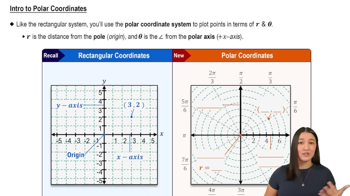
The coordinate plane is divided into four quadrants, each with specific signs for x and y coordinates. In Quadrant I, both x and y are positive, which affects the sign of ratios involving these values.
Recommended video:
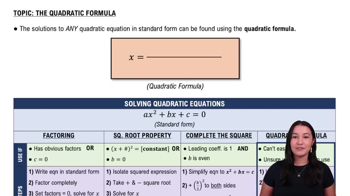
Quadratic Formula
Distance from Origin (r)
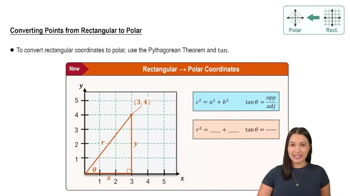
The distance r from the origin to a point (x, y) is given by r = √(x² + y²), which is always positive. This value represents the radius in polar coordinates and is crucial for understanding ratios involving r.
Recommended video:
Convert Points from Rectangular to Polar
Sign of Ratios Involving Coordinates
The sign of a ratio like r/y depends on the signs of numerator and denominator. Since r is always positive, the sign of r/y depends solely on y's sign, which varies by quadrant, helping determine if the ratio is positive or negative.
Recommended video:
Intro to Polar Coordinates
Related Practice
Textbook Question
549
views
Textbook Question
Solve each problem. Height of a Lunar Peak The lunar mountain peak Huygens has a height of 21,000 ft. The shadow of Huygens on a photograph was 2.8 mm, while the nearby mountain Bradley had a shadow of 1.8 mm on the same photograph. Calculate the height of Bradley. (Data from Webb, T., Celestial Objects for Common Telescopes, Dover Publications.)
696
views
Textbook Question
Perform each calculation. See Example 3. 90° ― 36° 18' 47"
522
views
Textbook Question
Identify the quadrant (or possible quadrants) of an angle θ that satisfies the given conditions. See Example 3.
csc θ > 0 , cot θ > 0
1096
views
Textbook Question
Perform each calculation. See Example 3. 90° ― 17° 13'
627
views
Textbook Question
Identify the quadrant (or possible quadrants) of an angle θ that satisfies the given conditions. See Example 3.
tan θ < 0 , cot θ < 0
1092
views