Ch. 7 - Applications of Trigonometry and Vectors
Lial - Trigonometry 12th Edition
Lial12th EditionTrigonometryISBN: 9780136552161Not the one you use?Change textbook
Chapter 8, Problem 7.21

Solve each triangle. See Examples 2 and 3.


C = 45.6°, b = 8.94 m, a = 7.23 m

Verified step by step guidance
1
Step 1: Identify the given information. You have angle C = 45.6°, side b = 8.94 m, and side a = 7.23 m.
Step 2: Use the Law of Cosines to find the third side c. The formula is c^2 = a^2 + b^2 - 2ab \(\cos\)(C).
Step 3: Substitute the known values into the Law of Cosines formula: c^2 = (7.23)^2 + (8.94)^2 - 2(7.23)(8.94) \(\cos\)(45.6°).
Step 4: Solve for c by calculating the right-hand side of the equation and then taking the square root of the result.
Step 5: Use the Law of Sines to find the remaining angles A and B. The formula is \(\frac{a}{\sin(A)}\) = \(\frac{b}{\sin(B)}\) = \(\frac{c}{\sin(C)}\). Start with \(\frac{a}{\sin(A)}\) = \(\frac{c}{\sin(C)}\) to find angle A.

Verified video answer for a similar problem:

This video solution was recommended by our tutors as helpful for the problem above.
Was this helpful?

Key Concepts

Here are the essential concepts you must grasp in order to answer the question correctly.

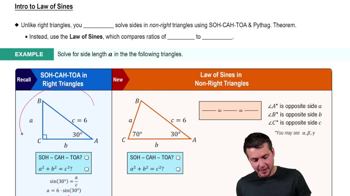
Law of Sines

The Law of Sines states that the ratios of the lengths of sides of a triangle to the sines of their opposite angles are constant. This principle is essential for solving triangles when given two angles and one side or two sides and a non-included angle. It allows for the calculation of unknown angles and sides, making it a fundamental tool in trigonometry.
Recommended video:
4:27
Intro to Law of Sines

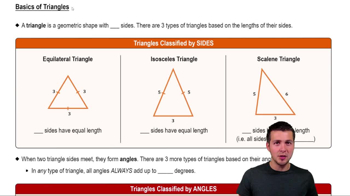
Triangle Properties

Understanding the properties of triangles, including the sum of angles in a triangle being 180 degrees, is crucial for solving triangle problems. In this case, knowing one angle and two sides allows for the determination of the remaining angles and sides. This foundational knowledge helps in applying the Law of Sines effectively.
Recommended video:
4:42
Review of Triangles

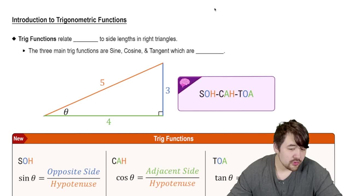
Trigonometric Functions

Trigonometric functions such as sine, cosine, and tangent relate the angles of a triangle to the ratios of its sides. These functions are vital for calculating unknown side lengths and angles in a triangle. Familiarity with these functions and their relationships is necessary for applying the Law of Sines and solving the given triangle.
Recommended video:
6:04
Introduction to Trigonometric Functions