In Exercises 49–58, convert each rectangular equation to a polar equation that expresses r in terms of θ. (x − 2)² + y² = 4
Ch. 5 - Complex Numbers, Polar Coordinates and Parametric Equations

All textbooks
Blitzer 3rd Edition
Ch. 5 - Complex Numbers, Polar Coordinates and Parametric Equations
Problem 5
Blitzer 3rd Edition
Ch. 5 - Complex Numbers, Polar Coordinates and Parametric Equations
Problem 5Chapter 5, Problem 5
In Exercises 1–8, parametric equations and a value for the parameter t are given. Find the coordinates of the point on the plane curve described by the parametric equations corresponding to the given value of t. x = 4 + 2 cos t, y = 3 + 5 sin t; t = π/2
Verified step by step guidance1
Identify the given parametric equations: \(x = 4 + 2 \cos t\) and \(y = 3 + 5 \sin t\).
Substitute the given parameter value \(t = \frac{\pi}{2}\) into the expression for \(x\): calculate \(x = 4 + 2 \cos \left( \frac{\pi}{2} \right)\).
Substitute the same parameter value \(t = \frac{\pi}{2}\) into the expression for \(y\): calculate \(y = 3 + 5 \sin \left( \frac{\pi}{2} \right)\).
Evaluate the trigonometric functions \(\cos \left( \frac{\pi}{2} \right)\) and \(\sin \left( \frac{\pi}{2} \right)\) using known unit circle values.
Combine the results from the previous steps to find the coordinates \((x, y)\) of the point on the curve corresponding to \(t = \frac{\pi}{2}\).

Verified video answer for a similar problem:
This video solution was recommended by our tutors as helpful for the problem above.
Video duration:
2mWas this helpful?
Key Concepts
Here are the essential concepts you must grasp in order to answer the question correctly.
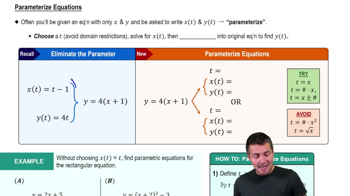
Parametric Equations
Parametric equations express the coordinates of points on a curve as functions of a parameter, often denoted as t. Instead of y as a function of x, both x and y depend on t, allowing the description of more complex curves like circles or ellipses.
Recommended video:
Parameterizing Equations
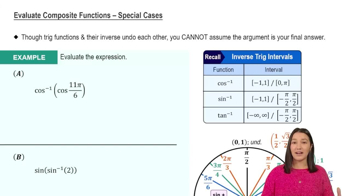
Evaluating Trigonometric Functions at Specific Angles
To find coordinates for a given parameter t, you substitute t into the trigonometric functions (cos t and sin t). Knowing exact values of sine and cosine at common angles like π/2 is essential for accurate calculation of points on the curve.
Recommended video:
Evaluate Composite Functions - Special Cases
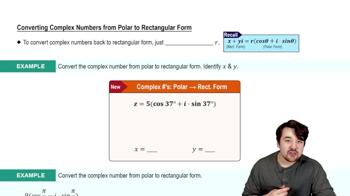
Coordinate Calculation from Parametric Form
Once the parameter value is substituted, calculate x and y by performing arithmetic operations on the trigonometric results. This yields the precise point (x, y) on the plane curve corresponding to the given t.
Recommended video:
Converting Complex Numbers from Polar to Rectangular Form
Related Practice
Textbook Question
876
views
Textbook Question
Evaluate x²+19 / 2−x for x = 3i.
721
views
Textbook Question
In Exercises 59–62, sketch the plane curve represented by the given parametric equations. Then use interval notation to give each relation's domain and range. x = t² + t + 1, y = 2t
749
views
Textbook Question
In Exercises 54–60, convert each polar equation to a rectangular equation. Then use your knowledge of the rectangular equation to graph the polar equation in a polar coordinate system. θ = 3π/4
788
views
Textbook Question
In Exercises 53–64, use DeMoivre's Theorem to find the indicated power of the complex number. Write answers in rectangular form. [√3 (cos (5π/18) + i sin (5π/18))]⁶
567
views
Textbook Question
In Exercises 1–10, plot each complex number and find its absolute value. z = 3 + 2i
594
views