Evaluate each expression without using a calculator. sin (arccos (3/4))
Verified step by step guidance
1
Recognize that the expression is \( \sin(\arccos(\frac{3}{4})) \). Here, \( \arccos(\frac{3}{4}) \) represents an angle \( \theta \) such that \( \cos \theta = \frac{3}{4} \).
Draw a right triangle to visualize the angle \( \theta \). Since \( \cos \theta = \frac{3}{4} \), the adjacent side to \( \theta \) is 3 and the hypotenuse is 4.
Use the Pythagorean theorem to find the opposite side: \( \text{opposite} = \sqrt{4^2 - 3^2} = \sqrt{16 - 9} \).
Calculate \( \sin \theta \) using the definition \( \sin \theta = \frac{\text{opposite}}{\text{hypotenuse}} \). Substitute the values found for the opposite side and hypotenuse.
Write the final expression for \( \sin(\arccos(\frac{3}{4})) \) as \( \frac{\sqrt{16 - 9}}{4} \), which simplifies the problem without using a calculator.
Verified video answer for a similar problem:
This video solution was recommended by our tutors as helpful for the problem above
Play a video:
0 Comments
Key Concepts
Here are the essential concepts you must grasp in order to answer the question correctly.
Inverse Trigonometric Functions
Inverse trigonometric functions, like arccos, return the angle whose trigonometric ratio matches a given value. For example, arccos(3/4) gives the angle whose cosine is 3/4. Understanding this helps translate the expression into a geometric or algebraic problem.
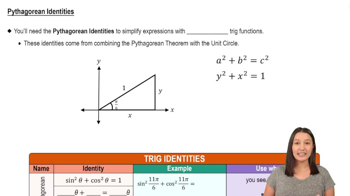
The Pythagorean identity states that sin²θ + cos²θ = 1 for any angle θ. This relationship allows us to find the sine of an angle if we know its cosine, by rearranging to sinθ = √(1 - cos²θ). This is essential for evaluating sin(arccos(3/4)) without a calculator.
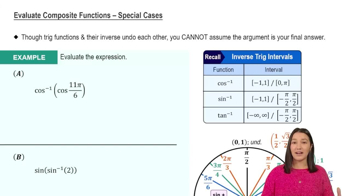
Evaluating expressions like sin(arccos(x)) involves substituting the inner function with an angle and then applying trigonometric identities. This process often uses right triangle interpretations or algebraic manipulation to find exact values without numerical approximation.

 Verified step by step guidance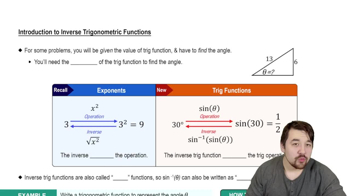
 4:28
4:28