Ch. 3 - Trigonometric Identities and Equations
Blitzer - Trigonometry 3rd Edition
Blitzer3rd EditionTrigonometryISBN: 9780137316601Not the one you use?Change textbook
Chapter 3, Problem 3.5.43

Exercises 39–52 involve trigonometric equations quadratic in form. Solve each equation on the interval [0, 2𝝅). 2 sin² x = sin x + 3

Verified step by step guidance
1
Rewrite the given equation to standard quadratic form by bringing all terms to one side: \(2 \sin^{2} x - \sin x - 3 = 0\).
Let \(u = \sin x\) to transform the trigonometric equation into a quadratic equation in terms of \(u\): \$2u^{2} - u - 3 = 0$.
Solve the quadratic equation \$2u^{2} - u - 3 = 0\( using the quadratic formula \(u = \frac{-b \pm \sqrt{b^{2} - 4ac}}{2a}\), where \)a=2\(, \)b=-1\(, and \)c=-3$.
Find the values of \(u\) (which represent \(\sin x\)) from the quadratic solutions and determine which values are valid since \(\sin x\) must be in the interval \([-1, 1]\).
For each valid \(u\) value, solve for \(x\) in the interval \([0, 2\pi)\) by using the inverse sine function and considering the sine function's periodicity and symmetry.

Verified video answer for a similar problem:

This video solution was recommended by our tutors as helpful for the problem above.
Video duration:
6m
Was this helpful?

Key Concepts

Here are the essential concepts you must grasp in order to answer the question correctly.

Quadratic Form in Trigonometric Equations

Some trigonometric equations can be rewritten to resemble quadratic equations by expressing terms like sin²x or cos²x as a single variable squared. This allows the use of algebraic methods such as factoring or the quadratic formula to find solutions for the trigonometric function.
Recommended video:
5:35
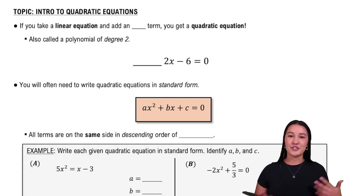
Introduction to Quadratic Equations

Solving Trigonometric Equations on a Specific Interval

When solving trigonometric equations, it is important to find all solutions within the given interval, here [0, 2π). This involves determining all angle values that satisfy the equation within one full cycle of the sine or cosine function.
Recommended video:
4:34
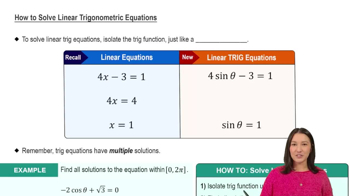
How to Solve Linear Trigonometric Equations

Using the Unit Circle to Find Angle Solutions

The unit circle provides a geometric interpretation of sine and cosine values for angles between 0 and 2π. By knowing the sine values corresponding to specific angles, one can identify all solutions to the equation within the interval.
Recommended video:
06:11
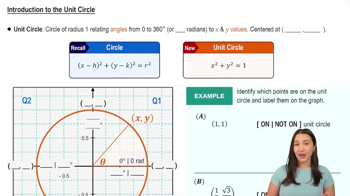
Introduction to the Unit Circle