Ch. R - Algebra Review
Lial - Trigonometry 12th Edition
Lial12th EditionTrigonometryISBN: 9780136552161Not the one you use?Change textbook
Chapter 1, Problem 75

Graph each function. See Examples 6–8. ƒ(x) = √-x

Verified step by step guidance
1
Recognize that the function is given by \(f(x) = \sqrt{-x}\), which means the square root of the negative of \(x\).
Determine the domain of the function by setting the expression inside the square root to be greater than or equal to zero: \(-x \geq 0\).
Solve the inequality \(-x \geq 0\) to find the domain: this simplifies to \(x \leq 0\), so the function is defined only for \(x\) values less than or equal to zero.
Choose several values of \(x\) within the domain (for example, \(x = 0, -1, -4, -9\)) and calculate the corresponding \(f(x)\) values by substituting into \(f(x) = \sqrt{-x}\).
Plot the points \((x, f(x))\) on the coordinate plane and sketch the curve, noting that the graph will be the right half of the standard square root function reflected over the y-axis because of the negative inside the square root.

Verified video answer for a similar problem:

This video solution was recommended by our tutors as helpful for the problem above.
Video duration:
2m
Was this helpful?

Key Concepts

Here are the essential concepts you must grasp in order to answer the question correctly.

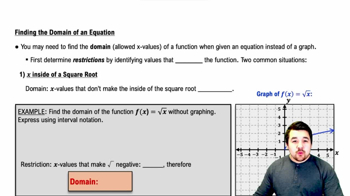
Domain of a Function

The domain of a function is the set of all input values (x) for which the function is defined. For functions involving square roots, the expression inside the root must be non-negative to yield real values. Understanding domain restrictions is essential to correctly graph the function.
Recommended video:
3:43
Finding the Domain of an Equation

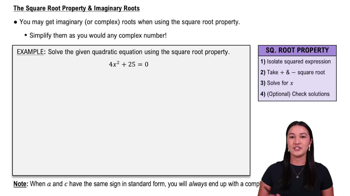
Square Root Function

The square root function, √x, outputs the non-negative number whose square is x. When the input is negative, the function is not defined in the real numbers. Modifications inside the root, such as √(-x), affect the domain and shape of the graph.
Recommended video:
2:20
Imaginary Roots with the Square Root Property

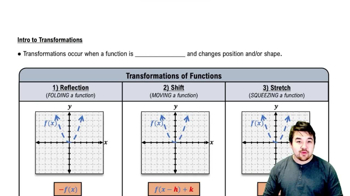
Graphing Transformations

Graphing transformations involve shifting, reflecting, or stretching the basic graph of a function. For example, √(-x) reflects the graph of √x across the y-axis. Recognizing these transformations helps in sketching the graph accurately.
Recommended video:
5:25
Introduction to Transformations