In Exercises 83–94, use a right triangle to write each expression as an algebraic expression. Assume that x is positive and that the given inverse trigonometric function is defined for the expression in x. sin (tan⁻¹ x)
Verified step by step guidance
1
Recognize that \( \sin(\tan^{-1} x) \) involves a composition of trigonometric functions where \( \tan^{-1} x \) represents an angle \( \theta \) such that \( \tan \theta = x \).
Draw a right triangle to represent the angle \( \theta \). Since \( \tan \theta = \frac{\text{opposite}}{\text{adjacent}} = x \), assign the opposite side length as \( x \) and the adjacent side length as \( 1 \) (choosing 1 for simplicity).
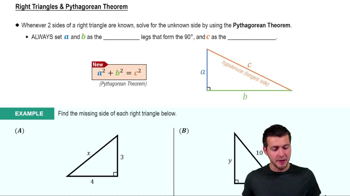
Use the Pythagorean theorem to find the hypotenuse of the triangle: \( \text{hypotenuse} = \sqrt{x^2 + 1^2} = \sqrt{x^2 + 1} \).
Express \( \sin \theta \) in terms of the sides of the triangle: \( \sin \theta = \frac{\text{opposite}}{\text{hypotenuse}} = \frac{x}{\sqrt{x^2 + 1}} \).
Therefore, \( \sin(\tan^{-1} x) = \frac{x}{\sqrt{x^2 + 1}} \), which is the algebraic expression for the original expression.
Verified video answer for a similar problem:
This video solution was recommended by our tutors as helpful for the problem above
Video duration:
3m
Play a video:
0 Comments
Key Concepts
Here are the essential concepts you must grasp in order to answer the question correctly.
Inverse Trigonometric Functions
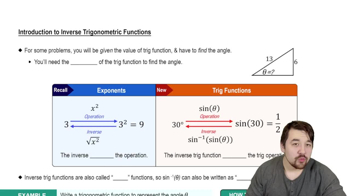
Inverse trigonometric functions, like tan⁻¹(x), return an angle whose trigonometric ratio equals x. For tan⁻¹(x), it gives an angle θ such that tan(θ) = x. Understanding this allows us to interpret expressions like sin(tan⁻¹ x) in terms of a right triangle.
Right Triangle Definitions of Trigonometric Ratios
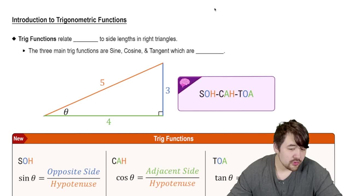
Trigonometric ratios (sine, cosine, tangent) can be defined using the sides of a right triangle. For an angle θ, sin(θ) = opposite/hypotenuse and tan(θ) = opposite/adjacent. Using these definitions helps convert inverse trig expressions into algebraic forms by constructing a triangle based on the given ratio.
Solving Right Triangles with the Pythagorean Theorem
Algebraic Expression from Trigonometric Ratios
Once a right triangle is constructed from an inverse trig function, the other trigonometric ratios can be expressed algebraically using the Pythagorean theorem. For example, if tan(θ) = x = opposite/adjacent, then hypotenuse = √(x² + 1), allowing sin(θ) to be written as x/√(x² + 1).

 3:52 minutes
 Verified step by step guidance
 4:28
4:28