Ch. 1 - Angles and the Trigonometric Functions
Blitzer - Trigonometry 3rd Edition
Blitzer3rd EditionTrigonometryISBN: 9780137316601Not the one you use?Change textbook
Chapter 1, Problem 33

In Exercises 31–38, find a cofunction with the same value as the given expression. csc 25°

Verified step by step guidance
1
Recall the definition of a cofunction: for an angle \( \theta \), the cofunction identity states that \( \sin(90^\circ - \theta) = \cos \theta \) and similarly for other trigonometric functions, such as \( \csc(\theta) = \sec(90^\circ - \theta) \).
Identify the given function: \( \csc 25^\circ \) is the cosecant of 25 degrees, which is the reciprocal of sine, i.e., \( \csc \theta = \frac{1}{\sin \theta} \).
Use the cofunction identity for cosecant: \( \csc \theta = \sec(90^\circ - \theta) \). This means \( \csc 25^\circ = \sec(90^\circ - 25^\circ) \).
Calculate the complementary angle inside the cofunction: \( 90^\circ - 25^\circ = 65^\circ \).
Write the cofunction with the same value as the original expression: \( \csc 25^\circ = \sec 65^\circ \).

Verified video answer for a similar problem:

This video solution was recommended by our tutors as helpful for the problem above.
Video duration:
1m
Was this helpful?

Key Concepts

Here are the essential concepts you must grasp in order to answer the question correctly.

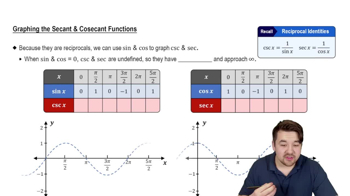
Cosecant Function (csc)

The cosecant function is the reciprocal of the sine function, defined as csc θ = 1/sin θ. It is used to find the ratio of the hypotenuse to the opposite side in a right triangle. Understanding csc is essential to relate it to other trigonometric functions.
Recommended video:
6:22
Graphs of Secant and Cosecant Functions

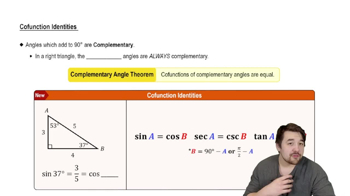
Cofunction Identity

Cofunction identities relate trigonometric functions of complementary angles, such as sin(90° - θ) = cos θ. These identities help find equivalent expressions by switching between pairs like sine and cosine or tangent and cotangent for angles summing to 90°.
Recommended video:
6:30
Cofunction Identities

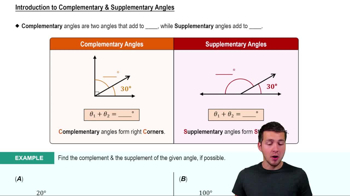
Complementary Angles

Complementary angles are two angles whose measures add up to 90°. In trigonometry, many function values at an angle θ correspond to cofunctions at 90° - θ, enabling simplification or transformation of expressions using cofunction identities.
Recommended video:
3:35
Intro to Complementary & Supplementary Angles