In Exercises 1–8, parametric equations and a value for the parameter t are given. Find the coordinates of the point on the plane curve described by the parametric equations corresponding to the given value of t. x = 3 − 5t, y = 4 + 2t; t = 1
Verified step by step guidance
1
Identify the given parametric equations: \(x = 3 - 5t\) and \(y = 4 + 2t\), and the given parameter value \(t = 1\).
Substitute the value of \(t = 1\) into the equation for \(x\): calculate \(x = 3 - 5(1)\).
Substitute the value of \(t = 1\) into the equation for \(y\): calculate \(y = 4 + 2(1)\).
Simplify both expressions to find the numerical values of \(x\) and \(y\) at \(t = 1\).
Write the coordinates of the point on the curve as \((x, y)\) using the values found in the previous step.
Verified video answer for a similar problem:
This video solution was recommended by our tutors as helpful for the problem above
Video duration:
2m
Play a video:
0 Comments
Key Concepts
Here are the essential concepts you must grasp in order to answer the question correctly.
Parametric Equations
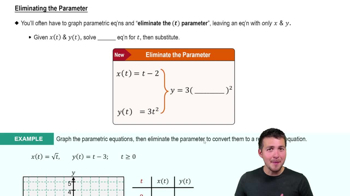
Parametric equations express the coordinates of points on a curve as functions of a parameter, usually denoted as t. Instead of y as a function of x, both x and y depend on t, allowing the description of more complex curves and motions.
To find a specific point on a parametric curve, substitute the given parameter value into the parametric equations. This yields the corresponding x and y coordinates, pinpointing the exact location on the curve for that parameter.
Understanding how coordinates (x, y) represent points on a plane is essential. By evaluating parametric equations at a given t, you determine a point's position in the Cartesian plane, which helps visualize and analyze the curve's shape and behavior.

 2:11 minutes
 Verified step by step guidance
 08:02
08:02