Ch. 3 - Trigonometric Identities and Equations
Blitzer - Trigonometry 3rd Edition
Blitzer3rd EditionTrigonometryISBN: 9780137316601Not the one you use?Change textbook
Chapter 3, Problem 65

In Exercises 54–67, solve each equation on the interval [0, 2𝝅). Use exact values where possible or give approximate solutions correct to four decimal places. 5 cos² x - 3 = 0

Verified step by step guidance
1
Start with the given equation: \(5 \cos^{2} x - 3 = 0\).
Isolate the cosine squared term by adding 3 to both sides: \(5 \cos^{2} x = 3\).
Divide both sides by 5 to solve for \(\cos^{2} x\): \(\cos^{2} x = \frac{3}{5}\).
Take the square root of both sides to solve for \(\cos x\): \(\cos x = \pm \sqrt{\frac{3}{5}}\).
Find all values of \(x\) in the interval \([0, 2\pi)\) where \(\cos x = \sqrt{\frac{3}{5}}\) and where \(\cos x = -\sqrt{\frac{3}{5}}\), using the unit circle or inverse cosine function.

Verified video answer for a similar problem:

This video solution was recommended by our tutors as helpful for the problem above.
Video duration:
7m
Was this helpful?

Key Concepts

Here are the essential concepts you must grasp in order to answer the question correctly.

Solving Quadratic Trigonometric Equations

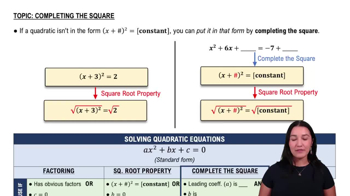
This involves treating trigonometric equations like algebraic quadratics by substituting expressions such as cos²x with a variable. After solving the quadratic equation, substitute back to find the trigonometric values and then solve for the angle x within the given interval.
Recommended video:
6:24
Solving Quadratic Equations by Completing the Square

Unit Circle and Interval Restrictions

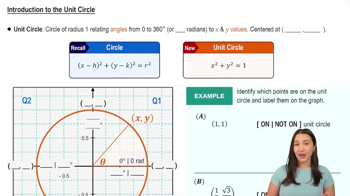
Understanding the unit circle helps identify all angle solutions for trigonometric equations within a specified interval, here [0, 2π). Since cosine values repeat every 2π, solutions must be found within one full rotation, considering both positive and negative cosine values.
Recommended video:
06:11
Introduction to the Unit Circle

Exact Values and Approximate Solutions

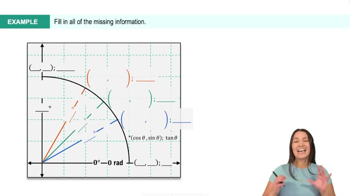
Exact values refer to well-known trigonometric values expressed in terms of π or simple fractions, while approximate solutions use decimal values rounded to a specified precision. Knowing when and how to use each is essential for providing answers as required by the problem.
Recommended video:
6:04
Example 1