Ch. R - Algebra Review
Lial - Trigonometry 12th Edition
Lial12th EditionTrigonometryISBN: 9780136552161Not the one you use?Change textbook
Chapter 1, Problem R.2.133

Rewrite each expression using the distributive property and simplify, if possible. See Example 7. 3/8 ( 16/9 y + 32/27 z - 40/9 )

Verified step by step guidance
1
First, rewrite the given expression clearly: \(\frac{3}{8} \left( \frac{16}{9} y + \frac{32}{27} z - \frac{40}{9} \right)\).
Apply the distributive property by multiplying \(\frac{3}{8}\) with each term inside the parentheses separately: \(\frac{3}{8} \times \frac{16}{9} y\), \(\frac{3}{8} \times \frac{32}{27} z\), and \(\frac{3}{8} \times \left(-\frac{40}{9}\right)\).
Multiply the numerators together and the denominators together for each term: For example, \(\frac{3 \times 16}{8 \times 9} y\), and similarly for the other terms.
Simplify each fraction by finding common factors in the numerator and denominator to reduce them to their simplest form.
After simplifying each term, write the final expression as the sum and difference of the simplified terms.

Verified video answer for a similar problem:

This video solution was recommended by our tutors as helpful for the problem above.
Video duration:
3m
Was this helpful?

Key Concepts

Here are the essential concepts you must grasp in order to answer the question correctly.

Distributive Property

The distributive property states that multiplying a sum or difference by a number is the same as multiplying each term inside the parentheses by that number separately, then adding or subtracting the results. For example, a(b + c) = ab + ac. This property is essential for rewriting and simplifying expressions involving sums or differences.
Recommended video:
2:20
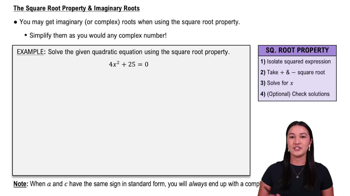
Imaginary Roots with the Square Root Property

Fraction Multiplication and Simplification

When multiplying fractions, multiply the numerators together and the denominators together. Simplify the resulting fraction by dividing numerator and denominator by their greatest common divisor. This process helps in reducing complex fractional expressions to simpler forms.
Recommended video:
4:02
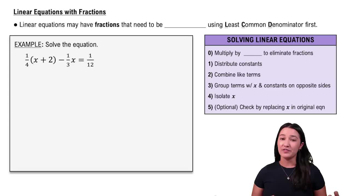
Solving Linear Equations with Fractions

Combining Like Terms

After distributing, terms with the same variable and exponent can be combined by adding or subtracting their coefficients. This simplification step reduces the expression to its simplest form, making it easier to interpret or use in further calculations.
Recommended video:
3:18
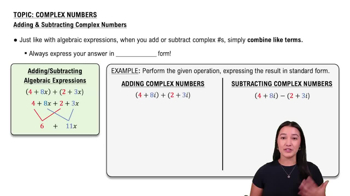
Adding and Subtracting Complex Numbers