
Textbook Question
Find the area of the sector of a circle of radius r formed by a central angle θ. Express area in terms of π. Then round your answer to two decimal places. Radius, r: 4 inches Central Angle, θ: θ = 240°
638
views

 Verified step by step guidance
 5:31
5:31
 6:22
6:22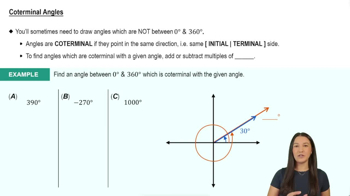 04:46
04:46Find the area of the sector of a circle of radius r formed by a central angle θ. Express area in terms of π. Then round your answer to two decimal places. Radius, r: 4 inches Central Angle, θ: θ = 240°
In Exercises 49–54, find the measure of the side of the right triangle whose length is designated by a lowercase letter. Round answers to the nearest whole number.
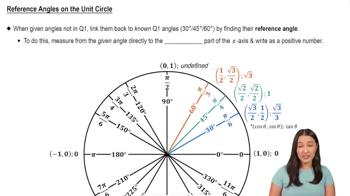
Use reference angles to find the exact value of each expression. Do not use a calculator. cot 19𝜋/6
Express each angular speed in radians per second. 6 revolutions per second
In Exercises 41–56, use the circle shown in the rectangular coordinate system to draw each angle in standard position. State the quadrant in which the angle lies. When an angle's measure is given in radians, work the exercise without converting to degrees.
16𝜋/3
In Exercises 49–54, find the measure of the side of the right triangle whose length is designated by a lowercase letter. Round answers to the nearest whole number.
<Image>