
Textbook Question
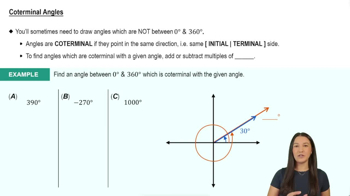
Write an expression that generates all angles coterminal with each angle. Let n represent any integer. ―90°
670
views

 Verified step by step guidance
 04:46
04:46 04:46
04:46 05:59
05:59Write an expression that generates all angles coterminal with each angle. Let n represent any integer. ―90°
Concept Check Suppose that ―90° < θ < 90° . Find the sign of each function value.
sec(―θ)
Concept Check Suppose that ―90° < θ < 90° . Find the sign of each function value. cos(θ―180°)
If n is an integer, n • 180° represents an integer multiple of 180°, (2n + 1) • 90° represents an odd integer multiple of 90° , and so on. Determine whether each expression is equal to 0, 1, or ―1, or is undefined. cot[n • 180°]
Concept Check Find a solution for each equation. tan (3θ ― 4°) = 1 / [cot(5θ ― 8°)]
If n is an integer, n • 180° represents an integer multiple of 180°, (2n + 1) • 90° represents an odd integer multiple of 90° , and so on. Determine whether each expression is equal to 0, 1, or ―1, or is undefined. sin[270° + n • 360°]