Ch. 4 - Laws of Sines and Cosines; Vectors
Blitzer - Trigonometry 3rd Edition
Blitzer3rd EditionTrigonometryISBN: 9780137316601Not the one you use?Change textbook
Chapter 4, Problem 49

In Exercises 45–50, determine whether v and w are parallel, orthogonal, or neither. v = 3i - 5j, w = 6i + 18 j 5

Verified step by step guidance
1
Identify the vectors \( \mathbf{v} = 3\mathbf{i} - 5\mathbf{j} \) and \( \mathbf{w} = 6\mathbf{i} + 18\mathbf{j} \). Write them in component form as \( \mathbf{v} = (3, -5) \) and \( \mathbf{w} = (6, 18) \).
To check if the vectors are parallel, see if one vector is a scalar multiple of the other. This means checking if there exists a scalar \( k \) such that \( (6, 18) = k(3, -5) \).
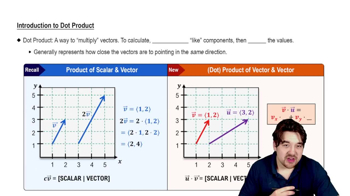
To check if the vectors are orthogonal (perpendicular), calculate their dot product using the formula \( \mathbf{v} \cdot \mathbf{w} = v_1 w_1 + v_2 w_2 \). If the dot product equals zero, the vectors are orthogonal.
Calculate the dot product \( \mathbf{v} \cdot \mathbf{w} = 3 \times 6 + (-5) \times 18 \).
Based on the results from the scalar multiple check and the dot product, conclude whether \( \mathbf{v} \) and \( \mathbf{w} \) are parallel, orthogonal, or neither.

Verified video answer for a similar problem:

This video solution was recommended by our tutors as helpful for the problem above.
Video duration:
1m
Was this helpful?

Key Concepts

Here are the essential concepts you must grasp in order to answer the question correctly.

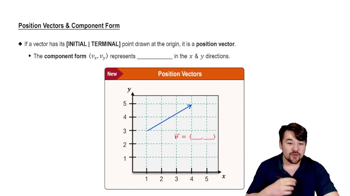
Vector Representation in Component Form

Vectors can be expressed in terms of their components along the coordinate axes, such as v = 3i - 5j, where i and j are unit vectors along the x and y axes. Understanding this form allows for straightforward calculation of vector operations like dot product and scalar multiplication.
Recommended video:
03:55
Position Vectors & Component Form

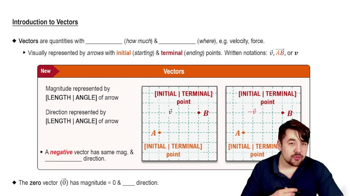
Parallel Vectors

Two vectors are parallel if one is a scalar multiple of the other, meaning their components are proportional. For example, if v = k * w for some scalar k, then v and w point in the same or opposite direction, indicating parallelism.
Recommended video:
03:48
Introduction to Vectors

Orthogonal Vectors and the Dot Product

Vectors are orthogonal (perpendicular) if their dot product equals zero. The dot product is calculated by multiplying corresponding components and summing the results. If v · w = 0, the vectors form a right angle.
Recommended video:
05:40
Introduction to Dot Product