Give all six trigonometric function values for each angle θ. Rationalize denominators when applicable. See Examples 5–7. tan θ = ―15/8 , and θ is in quadrant II .
Ch. 1 - Trigonometric Functions
Chapter 2, Problem 76
Find the indicated function value. If it is undefined, say so. See Example 4. cos 1800°
Verified step by step guidance1
Recognize that the cosine function is periodic with a period of 360°, meaning that \(\cos(\theta) = \cos(\theta + 360°k)\) for any integer \(k\).
To simplify \(\cos 1800°\), reduce the angle by subtracting multiples of 360° until the angle lies within the standard range of \$0°\( to \)360°\(. Calculate \(1800° - 360° \times k\) where \)k\( is chosen so the result is between \)0°\( and \)360°$.
Perform the calculation: \(1800° - 360° \times 5 = 1800° - 1800° = 0°\). So, \(\cos 1800° = \cos 0°\).
Recall the value of \(\cos 0°\), which is a fundamental trigonometric value.
Conclude that \(\cos 1800°\) is equal to \(\cos 0°\) and state the corresponding cosine value.

Verified video answer for a similar problem:
This video solution was recommended by our tutors as helpful for the problem above.
Video duration:
2mWas this helpful?
Key Concepts
Here are the essential concepts you must grasp in order to answer the question correctly.
Angle Measurement and Coterminal Angles
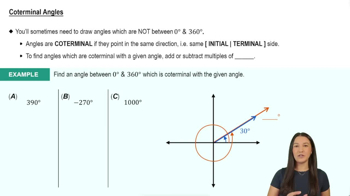
Angles can be measured in degrees and can exceed 360°, representing multiple rotations. Coterminal angles differ by full rotations of 360° and share the same trigonometric values. To find the value of a function at a large angle, reduce it by subtracting multiples of 360° to find an equivalent angle within 0° to 360°.
Recommended video:
Coterminal Angles
Cosine Function Properties
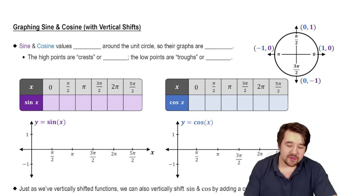
The cosine function relates an angle to the x-coordinate of a point on the unit circle. It is periodic with a period of 360°, meaning cos(θ) = cos(θ + 360°k) for any integer k. Cosine values range between -1 and 1 and are defined for all real angles.
Recommended video:
Graph of Sine and Cosine Function
Evaluating Trigonometric Functions at Specific Angles
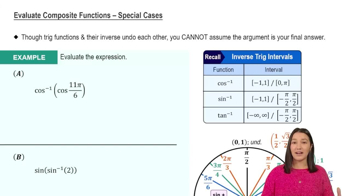
To evaluate cos 1800°, first find the coterminal angle by subtracting multiples of 360°. For example, 1800° - 5×360° = 0°, so cos 1800° = cos 0° = 1. This method simplifies calculations and helps determine if the function value is defined or undefined.
Recommended video:
Evaluate Composite Functions - Special Cases
Related Practice
Textbook Question
1021
views
Textbook Question
Convert each angle measure to degrees, minutes, and seconds. If applicable, round to the nearest second. 102.3771°
898
views
Textbook Question
Convert each angle measure to degrees, minutes, and seconds. If applicable, round to the nearest second. 122.6853°
656
views
Textbook Question
Give all six trigonometric function values for each angle θ. Rationalize denominators when applicable. See Examples 5–7.
sin θ = √5/7 , and θ is in quadrant I.
924
views
Textbook Question
Find the indicated function value. If it is undefined, say so. See Example 4. sec 1800°
662
views
Textbook Question
Find the angle of least positive measure (not equal to the given measure) that is coterminal with each angle. See Example 5. 26° 30'
873
views