
Textbook Question
Find the area of a sector of a circle having radius r and central angle θ. Express answers to the nearest tenth. See Example 5.
r = 40.0 mi, θ = 135°
971
views

 Verified step by step guidance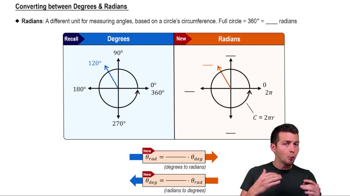
 5:04
5:04
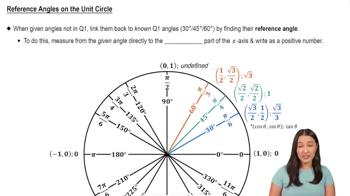 5:31
5:31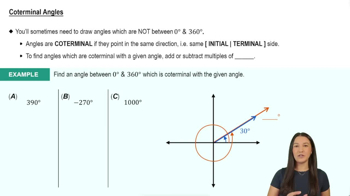 04:46
04:46Find the area of a sector of a circle having radius r and central angle θ. Express answers to the nearest tenth. See Example 5.
r = 40.0 mi, θ = 135°
Without using a calculator, decide whether each function value is positive or negative. (Hint: Consider the radian measures of the quadrantal angles, and remember that π ≈ 3.14.)
cos 6
Without using a calculator, decide whether each function value is positive or negative. (Hint: Consider the radian measures of the quadrantal angles, and remember that π ≈ 3.14.)
sin 5
Without using a calculator, decide whether each function value is positive or negative. (Hint: Consider the radian measures of the quadrantal angles, and remember that π ≈ 3.14.)
sin ( ―1)
Work each problem. See Example 5. Angle Measure Find the measure (in radians) of a central angle of a sector of area 16 in² a circle of radius 3.0 in.
Convert each radian measure to degrees. Write answers to the nearest minute. See Example 2(c).
5