Ch. R - Algebra Review
Lial - Trigonometry 12th Edition
Lial12th EditionTrigonometryISBN: 9780136552161Not the one you use?Change textbook
Chapter 1, Problem 13

Find each sum or difference. See Example 1. -15 + 6

Verified step by step guidance
1
Identify the operation involved in the expression. Here, it is a sum (addition) of two numbers: \(-15 + 6\).
Recall that adding a positive number to a negative number is equivalent to subtracting the smaller absolute value from the larger absolute value and keeping the sign of the number with the larger absolute value.
Compare the absolute values of the two numbers: \(|{-15}| = 15\) and \(|6| = 6\). Since 15 is greater, the result will have the sign of \(-15\), which is negative.
Subtract the smaller absolute value from the larger absolute value: \$15 - 6$.
Combine the sign from step 3 with the result from step 4 to write the final expression for the sum or difference.

Verified video answer for a similar problem:

This video solution was recommended by our tutors as helpful for the problem above.
Video duration:
59s
Was this helpful?

Key Concepts

Here are the essential concepts you must grasp in order to answer the question correctly.

Understanding Addition and Subtraction of Integers

This concept involves combining positive and negative numbers. Adding a negative number is equivalent to subtracting its absolute value, and subtracting a negative number is like adding its absolute value. Mastery of integer operations is essential for correctly evaluating expressions like -15 + 6.
Recommended video:
3:18
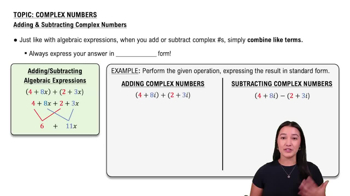
Adding and Subtracting Complex Numbers

Number Line Visualization

Using a number line helps visualize the addition or subtraction of integers. Starting at -15, moving 6 units to the right (since 6 is positive) shows the result. This spatial understanding aids in grasping how sums and differences of integers work.
Recommended video:
3:31
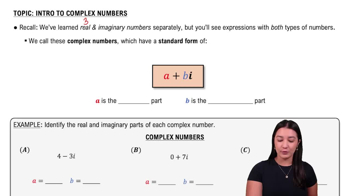
Introduction to Complex Numbers

Order of Operations and Simplification

Although this problem is straightforward, understanding the order of operations ensures correct evaluation in more complex expressions. Simplifying sums or differences step-by-step prevents errors and builds a foundation for handling trigonometric expressions involving arithmetic.
Recommended video:
04:12
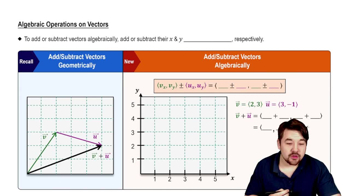
Algebraic Operations on Vectors