Find the exact value of each expression. See Example 3. sin 1305°
Verified step by step guidance
1
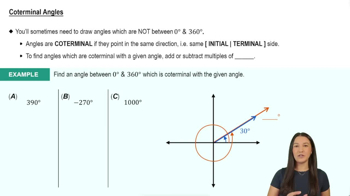
Recognize that the sine function has a period of 360°, so to find \( \sin 1305^\circ \), first reduce the angle by subtracting multiples of 360° until the angle lies between 0° and 360°. This can be done by calculating \( 1305^\circ - 3 \times 360^\circ \).
Calculate the reduced angle: \( 1305^\circ - 1080^\circ = 225^\circ \). So, \( \sin 1305^\circ = \sin 225^\circ \).
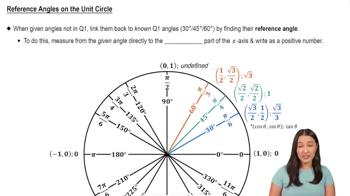
Recall that 225° is in the third quadrant, where sine values are negative. The reference angle for 225° is \( 225^\circ - 180^\circ = 45^\circ \).
Use the reference angle to express \( \sin 225^\circ \) in terms of \( \sin 45^\circ \), keeping in mind the sign in the third quadrant: \( \sin 225^\circ = -\sin 45^\circ \).
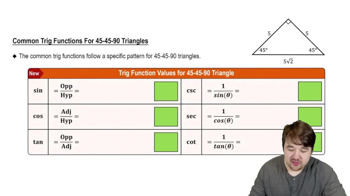
Recall the exact value of \( \sin 45^\circ = \frac{\sqrt{2}}{2} \), so \( \sin 1305^\circ = -\frac{\sqrt{2}}{2} \).
Verified video answer for a similar problem:
This video solution was recommended by our tutors as helpful for the problem above
Video duration:
3m
Play a video:
0 Comments
Key Concepts
Here are the essential concepts you must grasp in order to answer the question correctly.
Angle Reduction Using Coterminal Angles
Angles larger than 360° can be simplified by subtracting multiples of 360° to find a coterminal angle between 0° and 360°. This helps in evaluating trigonometric functions by reducing the angle to a standard position.
Once the angle is reduced, identifying its quadrant is essential because the sign and value of sine depend on the quadrant. The reference angle is the acute angle formed with the x-axis, used to find the sine value.
Certain angles like 30°, 45°, 60°, and their multiples have known exact sine values expressed in terms of square roots. Using these known values allows for precise calculation without a calculator.

 3:05 minutes
 Verified step by step guidance
 04:46
04:46