CONCEPT PREVIEW Determine whether each statement is possible or impossible. sin² θ + cos² θ = 2
Verified step by step guidance
1
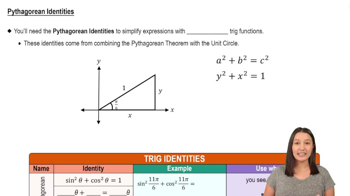
Recall the Pythagorean identity in trigonometry, which states that for any angle \( \theta \), the following equation holds:
\[ \sin^{2} \theta + \cos^{2} \theta = 1 \]
Understand that \( \sin^{2} \theta \) means \( (\sin \theta)^{2} \) and similarly for \( \cos^{2} \theta \). Both sine and cosine values range between -1 and 1, so their squares range between 0 and 1.
Since both \( \sin^{2} \theta \) and \( \cos^{2} \theta \) are non-negative and their sum is always exactly 1, check if the given statement \( \sin^{2} \theta + \cos^{2} \theta = 2 \) can ever be true.
Consider the maximum possible values of \( \sin^{2} \theta \) and \( \cos^{2} \theta \). The maximum value for each is 1, but since they are complementary in the identity, their sum cannot exceed 1.
Conclude that the statement \( \sin^{2} \theta + \cos^{2} \theta = 2 \) is impossible because it contradicts the fundamental Pythagorean identity.
Verified video answer for a similar problem:
This video solution was recommended by our tutors as helpful for the problem above
Video duration:
54s
Play a video:
0 Comments
Key Concepts
Here are the essential concepts you must grasp in order to answer the question correctly.
Pythagorean Identity
The Pythagorean identity states that for any angle θ, sin²θ + cos²θ = 1. This fundamental trigonometric identity is derived from the Pythagorean theorem and holds true for all real values of θ.
The sine and cosine functions each have values ranging between -1 and 1. Consequently, their squares, sin²θ and cos²θ, range from 0 to 1, which restricts the possible sums of these squares.
To determine if a trigonometric statement is possible, compare it against known identities and function ranges. Since sin²θ + cos²θ always equals 1, the statement sin²θ + cos²θ = 2 is impossible.

 0:54 minutes
 Verified step by step guidance
 6:25
6:25