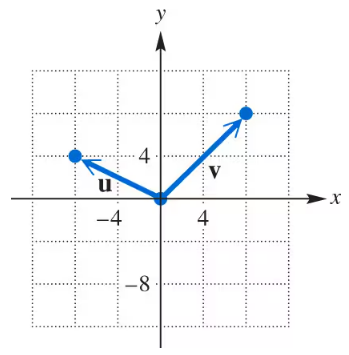
Use the figure to find each vector: - u. Use vector notation as in Example 4.
Ch. 7 - Applications of Trigonometry and Vectors
Chapter 8, Problem 31a
Use the figure to find each vector: u + v. Use vector notation as in Example 4.

Verified step by step guidance1
Identify the components of vectors \( \mathbf{u} \) and \( \mathbf{v} \) from the figure. Typically, each vector can be broken down into its horizontal (x) and vertical (y) components, such as \( \mathbf{u} = (u_x, u_y) \) and \( \mathbf{v} = (v_x, v_y) \).
Write down the components of \( \mathbf{u} \) and \( \mathbf{v} \) explicitly. For example, if \( \mathbf{u} \) points 3 units right and 4 units up, then \( \mathbf{u} = (3, 4) \). Do the same for \( \mathbf{v} \).
Add the corresponding components of the two vectors to find \( \mathbf{u} + \mathbf{v} \). This means calculating \( (u_x + v_x, u_y + v_y) \).
Express the resulting vector \( \mathbf{u} + \mathbf{v} \) in vector notation, for example, \( \mathbf{u} + \mathbf{v} = (u_x + v_x, u_y + v_y) \).
If needed, you can also represent the vector \( \mathbf{u} + \mathbf{v} \) graphically by drawing it from the origin or the tail of \( \mathbf{u} \) to the head of \( \mathbf{v} \), confirming the addition visually.

Verified video answer for a similar problem:
This video solution was recommended by our tutors as helpful for the problem above.
Was this helpful?
Key Concepts
Here are the essential concepts you must grasp in order to answer the question correctly.
Vector Addition
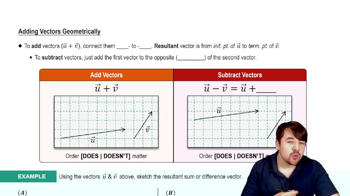
Vector addition involves combining two vectors to form a resultant vector by adding their corresponding components or by placing them head-to-tail graphically. The sum vector u + v represents the combined effect of vectors u and v.
Recommended video:
Adding Vectors Geometrically
Vector Notation
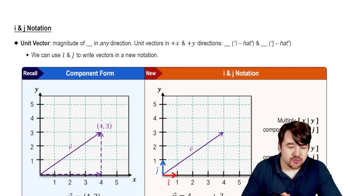
Vector notation typically expresses vectors in component form, such as ⟨x, y⟩, where x and y are the horizontal and vertical components. This notation simplifies calculations and clearly represents the vector's direction and magnitude.
Recommended video:
i & j Notation
Resolving Vectors into Components
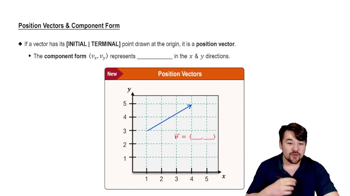
To add vectors accurately, each vector is broken down into horizontal and vertical components using trigonometric functions if angles are given. This allows for straightforward addition of components to find the resultant vector.
Recommended video:
Position Vectors & Component Form
Related Practice
Textbook Question
677
views
Textbook Question
Apply the law of sines to the following: a = √5, c = 2√5, A = 30°. What is the value of sin C? What is the measure of C? Based on its angle measures, what kind of triangle is triangle ABC?
706
views
Textbook Question
Use the figure to find each vector: u - v. Use vector notation as in Example 4.
747
views
Textbook Question
Solve each triangle. See Examples 2 and 3.
B = 74.8°, a = 8.92 in., c = 6.43 in.
719
views
Textbook Question
Two tugboats are pulling a disabled speedboat into port with forces of 1240 lb and 1480 lb. The angle between these forces is 28.2°. Find the direction and magnitude of the equilibrant.
815
views
Textbook Question
Two rescue vessels are pulling a broken-down motorboat toward a boathouse with forces of 840 lb and 960 lb. The angle between these forces is 24.5°. Find the direction and magnitude of the equilibrant.
801
views