Ch. 1 - Angles and the Trigonometric Functions
Blitzer - Trigonometry 3rd Edition
Blitzer3rd EditionTrigonometryISBN: 9780137316601Not the one you use?Change textbook
Chapter 1, Problem 37

In Exercises 35–40, convert each angle in radians to degrees. Round to two decimal places. πœ‹/13 radians

Verified step by step guidance
1
Recall the formula to convert radians to degrees: \(\text{degrees} = \text{radians} \times \frac{180}{\pi}\).
Substitute the given angle \(\frac{\pi}{13}\) radians into the formula: \(\text{degrees} = \frac{\pi}{13} \times \frac{180}{\pi}\).
Simplify the expression by canceling out \(\pi\): \(\text{degrees} = \frac{180}{13}\).
Divide 180 by 13 to get the decimal value of the angle in degrees.
Round the result to two decimal places as required.

Verified video answer for a similar problem:

This video solution was recommended by our tutors as helpful for the problem above.
Video duration:
2m
Was this helpful?

Key Concepts

Here are the essential concepts you must grasp in order to answer the question correctly.

Radian Measure

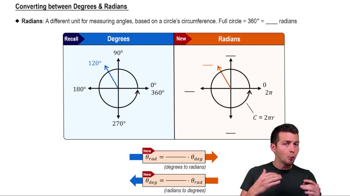
A radian is a unit of angular measure based on the radius of a circle. One radian is the angle created when the arc length equals the radius. It is a standard unit in trigonometry and is related to degrees by the formula 2Ο€ radians = 360 degrees.
Recommended video:
5:04
Converting between Degrees & Radians

Conversion Between Radians and Degrees

To convert radians to degrees, multiply the radian measure by 180/Ο€. This conversion factor comes from the equivalence of 2Ο€ radians to 360 degrees, simplifying to 1 radian = 180/Ο€ degrees.
Recommended video:
5:04
Converting between Degrees & Radians

Rounding Decimal Values

After converting the angle to degrees, round the result to the specified number of decimal places, in this case, two. Rounding ensures the answer is precise and presented in a standard format for clarity.
Recommended video:
5:08
Sine, Cosine, & Tangent of 30Β°, 45Β°, & 60Β°