Match each equation with its polar graph from choices A–D. r = cos 3θ
Verified step by step guidance
1
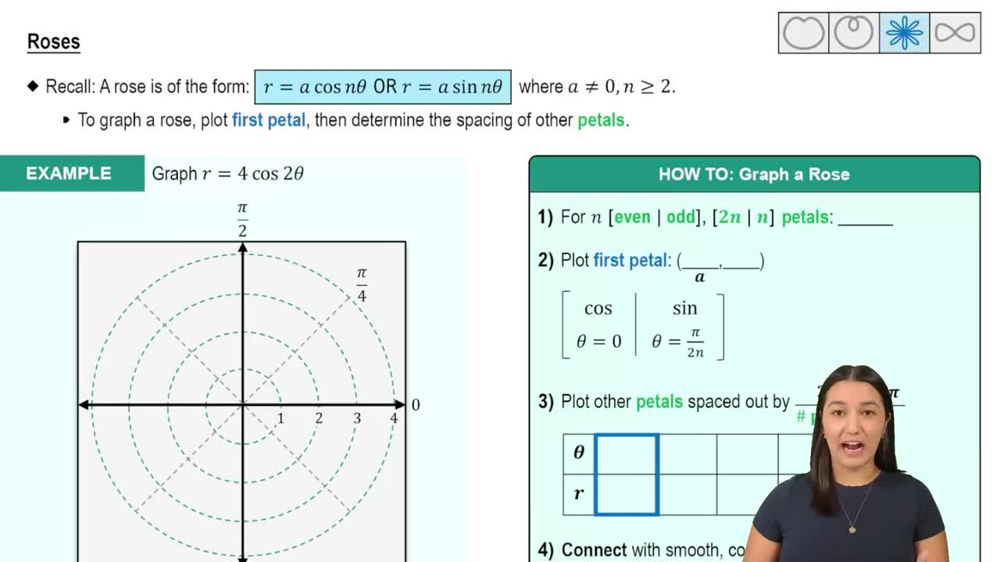
Recognize that the equation is given in polar form: \(r = \cos 3\theta\). This represents a rose curve, a common type of polar graph.
Recall the general form of rose curves: \(r = \cos n\theta\) or \(r = \sin n\theta\), where \(n\) determines the number of petals.
Determine the number of petals based on \(n\). If \(n\) is odd, the rose has \(n\) petals; if \(n\) is even, it has \$2n\( petals. Here, \)n = 3$, so the graph will have 3 petals.
Understand the orientation: since the equation uses cosine, one petal will lie along the polar axis (the positive \(x\)-axis), and the petals will be symmetrically spaced around the origin.
Use this information to match the equation \(r = \cos 3\theta\) with the graph that shows a 3-petal rose curve oriented with a petal on the positive \(x\)-axis.
Verified video answer for a similar problem:
This video solution was recommended by our tutors as helpful for the problem above
Video duration:
7m
Play a video:
0 Comments
Key Concepts
Here are the essential concepts you must grasp in order to answer the question correctly.
Polar Coordinates and Graphs
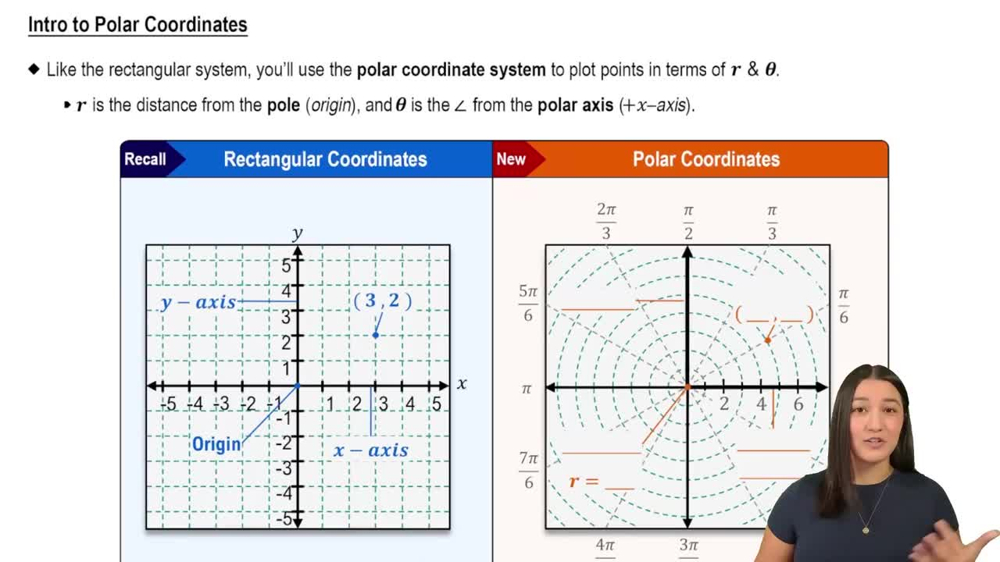
Polar coordinates represent points using a radius and an angle (r, θ) instead of Cartesian (x, y). Graphs in polar form plot r as a function of θ, often producing curves like circles, roses, or spirals. Understanding how r changes with θ is essential to visualize the graph.
Equations of the form r = cos(nθ) or r = sin(nθ) produce rose curves with petals. If n is odd, the rose has n petals; if n is even, it has 2n petals. For r = cos 3θ, the graph will have 3 petals symmetrically arranged around the origin.
The cosine function oscillates between -1 and 1, affecting the radius r in polar graphs. Positive values of r plot points outward, while negative values reflect points across the origin. This oscillation creates the petal shapes and symmetry in graphs like r = cos 3θ.

 7:57 minutes
 Verified step by step guidance
 05:32
05:32