Simplify each expression. See Example 8. 3(k + 2) - 5k + 6 + 3
Verified step by step guidance
1
Distribute the 3 across the terms inside the parentheses: write the expression as \(3 \times k + 3 \times 2 - 5k + 6 + 3\).
Simplify the multiplication to get \$3k + 6 - 5k + 6 + 3$.
Combine like terms involving \(k\): \$3k - 5k$.
Combine the constant terms: \$6 + 6 + 3$.
Write the simplified expression by adding the results from the previous two steps.
Verified video answer for a similar problem:
This video solution was recommended by our tutors as helpful for the problem above
Video duration:
2m
Play a video:
0 Comments
Key Concepts
Here are the essential concepts you must grasp in order to answer the question correctly.
Distributive Property
The distributive property allows you to multiply a single term by each term inside a parenthesis. For example, a(b + c) = ab + ac. This is essential for expanding expressions like 3(k + 2) before combining like terms.
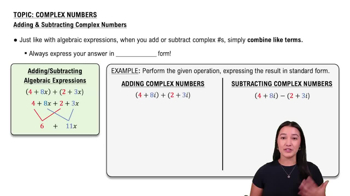
Combining like terms involves adding or subtracting terms that have the same variable raised to the same power. For instance, 3k and -5k can be combined to simplify the expression. This step reduces the expression to its simplest form.
Simplifying constants means adding or subtracting the numerical values without variables. In the expression, constants like 6 and 3 can be combined to simplify the overall expression. This helps in achieving the final simplified result.

 2:07 minutes
 Verified step by step guidance
 2:20
2:20