Ch. 7 - Applications of Trigonometry and Vectors
Lial - Trigonometry 12th Edition
Lial12th EditionTrigonometryISBN: 9780136552161Not the one you use?Change textbook
Chapter 8, Problem 41b

Given vectors u and v, find: 2u + 3v.
u = 2i, v = i + j

Verified step by step guidance
1
Identify the given vectors: \( \mathbf{u} = 2\mathbf{i} \) and \( \mathbf{v} = \mathbf{i} + \mathbf{j} \).
Multiply vector \( \mathbf{u} \) by 2: calculate \( 2\mathbf{u} = 2 \times 2\mathbf{i} \).
Multiply vector \( \mathbf{v} \) by 3: calculate \( 3\mathbf{v} = 3 \times (\mathbf{i} + \mathbf{j}) \).
Add the resulting vectors from the previous two steps: \( 2\mathbf{u} + 3\mathbf{v} \).
Combine like terms (i.e., the \( \mathbf{i} \) components together and the \( \mathbf{j} \) components together) to express the final vector in terms of \( \mathbf{i} \) and \( \mathbf{j} \).

Verified video answer for a similar problem:

This video solution was recommended by our tutors as helpful for the problem above.
Was this helpful?

Key Concepts

Here are the essential concepts you must grasp in order to answer the question correctly.

Vector Representation in Component Form

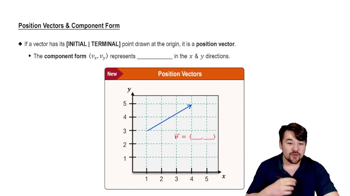
Vectors can be expressed as sums of their components along standard unit vectors, typically i and j in two dimensions. For example, u = 2i means the vector has a component 2 along the x-axis and 0 along the y-axis. Understanding this form allows for straightforward vector addition and scalar multiplication.
Recommended video:
03:55
Position Vectors & Component Form

Scalar Multiplication of Vectors

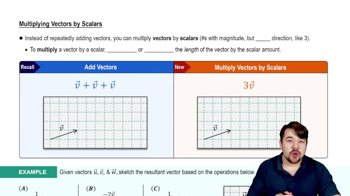
Scalar multiplication involves multiplying each component of a vector by a scalar (a real number). For instance, multiplying vector u by 2 scales its magnitude by 2 without changing its direction. This operation is essential for combining vectors with different weights, as in 2u + 3v.
Recommended video:
05:05
Multiplying Vectors By Scalars

Vector Addition

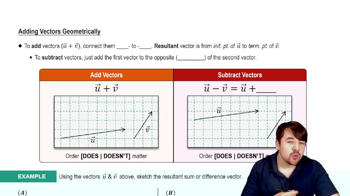
Vector addition is performed by adding corresponding components of the vectors. For example, adding vectors a = a₁i + a₂j and b = b₁i + b₂j results in (a₁ + b₁)i + (a₂ + b₂)j. This principle is used to find the resultant vector 2u + 3v by first scaling and then adding the vectors.
Recommended video:
05:29
Adding Vectors Geometrically