Ch. 3 - Trigonometric Identities and Equations
Blitzer - Trigonometry 3rd Edition
Blitzer3rd EditionTrigonometryISBN: 9780137316601Not the one you use?Change textbook
Chapter 3, Problem 17

Use a sum or difference formula to find the exact value of each expression. tan 5𝝅/12

Verified step by step guidance
1
Identify the angle given: \( \frac{5\pi}{12} \). Notice that \( \frac{5\pi}{12} \) can be expressed as a sum or difference of angles whose tangent values are known. For example, \( \frac{5\pi}{12} = \frac{\pi}{3} + \frac{\pi}{4} \) because \( \frac{\pi}{3} = \frac{4\pi}{12} \) and \( \frac{\pi}{4} = \frac{3\pi}{12} \), and their sum is \( \frac{7\pi}{12} \), so check carefully for the correct decomposition.
Find two angles \( A \) and \( B \) such that \( \frac{5\pi}{12} = A + B \) or \( A - B \), where \( A \) and \( B \) are standard angles with known tangent values. For example, \( \frac{5\pi}{12} = \frac{\pi}{4} + \frac{\pi}{6} \) because \( \frac{\pi}{4} = \frac{3\pi}{12} \) and \( \frac{\pi}{6} = \frac{2\pi}{12} \), and their sum is \( \frac{5\pi}{12} \).
Use the tangent sum formula: \( \tan(A + B) = \frac{\tan A + \tan B}{1 - \tan A \tan B} \). Substitute \( A = \frac{\pi}{4} \) and \( B = \frac{\pi}{6} \) into this formula.
Recall the exact values: \( \tan \frac{\pi}{4} = 1 \) and \( \tan \frac{\pi}{6} = \frac{1}{\sqrt{3}} \). Substitute these values into the formula to express \( \tan \frac{5\pi}{12} \) in terms of known numbers.
Simplify the resulting expression by performing the addition and subtraction in the numerator and denominator to get the exact value of \( \tan \frac{5\pi}{12} \).

Verified video answer for a similar problem:

This video solution was recommended by our tutors as helpful for the problem above.
Video duration:
5m
Was this helpful?

Key Concepts

Here are the essential concepts you must grasp in order to answer the question correctly.

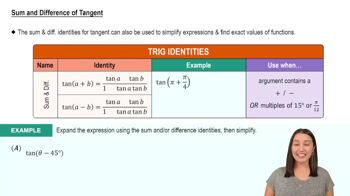
Sum and Difference Formulas for Tangent

These formulas express the tangent of a sum or difference of two angles in terms of the tangents of the individual angles. Specifically, tan(a ± b) = (tan a ± tan b) / (1 ∓ tan a tan b). They are essential for breaking down complex angles into simpler parts whose tangent values are known.
Recommended video:
4:47
Sum and Difference of Tangent

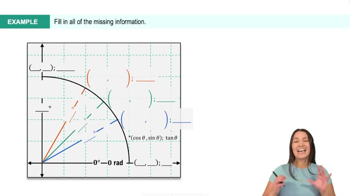
Exact Values of Tangent for Special Angles

Certain angles like π/6, π/4, and π/3 have known exact tangent values (e.g., tan(π/4) = 1). Recognizing these angles helps in applying sum or difference formulas effectively to find exact values without approximations.
Recommended video:
6:04
Example 1

Angle Decomposition

This involves expressing a given angle as a sum or difference of angles with known trigonometric values. For example, 5π/12 can be written as π/3 + π/4, enabling the use of sum formulas to find exact trigonometric values.
Recommended video:
04:46
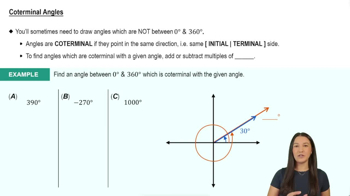
Coterminal Angles