Ch. R - Algebra Review
Lial - Trigonometry 12th Edition
Lial12th EditionTrigonometryISBN: 9780136552161Not the one you use?Change textbook
Chapter 1, Problem R.2.69

Concept Check Evaluate each exponential expression. a. 8² b. -8² c. (-8)² d. -(-8)²

Verified step by step guidance
1
Understand the difference between the base and the exponent in each expression. The exponent indicates how many times the base is multiplied by itself.
For part a, evaluate \$8^2$ by multiplying 8 by itself: \(8 \times 8\).
For part b, note the expression is \(-8^2\). According to order of operations, evaluate the exponent first, then apply the negative sign. So calculate \$8^2$ first, then apply the negative sign.
For part c, the expression is \((-8)^2\). Here, the negative sign is inside the parentheses, so the entire number -8 is squared. Multiply -8 by -8.
For part d, the expression is \(-(-8)^2\). First, evaluate \((-8)^2\) as in part c, then apply the negative sign outside the parentheses.

Verified video answer for a similar problem:

This video solution was recommended by our tutors as helpful for the problem above.
Video duration:
1m
Was this helpful?

Key Concepts

Here are the essential concepts you must grasp in order to answer the question correctly.

Order of Operations (PEMDAS)

The order of operations dictates the sequence in which mathematical operations are performed. Exponents are evaluated before multiplication, division, addition, or subtraction. This is crucial for correctly interpreting expressions like -8², where the exponent applies before the negative sign.
Recommended video:
04:12
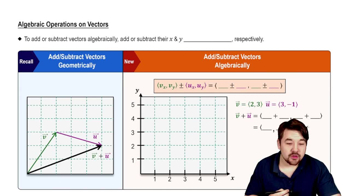
Algebraic Operations on Vectors

Exponents and Powers

An exponent indicates how many times a base number is multiplied by itself. For example, 8² means 8 × 8 = 64. Understanding how to apply exponents to positive and negative bases, including parentheses, is essential for evaluating expressions like (-8)².
Recommended video:
03:05
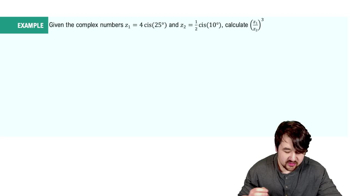
Powers Of Complex Numbers In Polar Form (DeMoivre's Theorem) Example 1

Negative Signs and Parentheses

Parentheses affect how negative signs interact with exponents. Without parentheses, -8² means the negative of 8 squared, resulting in -64. With parentheses, (-8)² means -8 multiplied by itself, resulting in a positive 64. Recognizing this distinction is key to evaluating expressions correctly.
Recommended video:
4:45
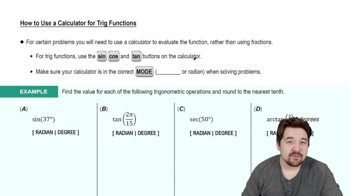
How to Use a Calculator for Trig Functions