The graph of a cotangent function is given. Select the equation for each graph from the following options: y = cot(x + π/2), y = cot(x + π), y = −cot x, y= −cot(x − π/2).
Verified step by step guidance
1
Identify the vertical asymptotes of the cotangent graph. From the graph, the vertical asymptotes are at \(x = -\frac{2\pi}{3}\) and \(x = \frac{\pi}{3}\).
Recall that the standard cotangent function \(y = \cot x\) has vertical asymptotes at \(x = k\pi\), where \(k\) is an integer. The period of \(\cot x\) is \(\pi\).
Compare the given asymptotes with the standard cotangent asymptotes. The asymptotes here are shifted compared to the standard \(x = 0\) and \(x = \pi\) asymptotes of \(y = \cot x\).
Calculate the horizontal shift by comparing the asymptotes. The shift appears to be \(-\frac{\pi}{3}\) from the standard positions, indicating a phase shift in the function.
Match the phase shift and reflection with the given options. Since the graph is shifted and the shape matches a negative cotangent function shifted by \(\frac{\pi}{2}\), the equation corresponds to \(y = -\cot(x - \frac{\pi}{2})\).
Verified video answer for a similar problem:
This video solution was recommended by our tutors as helpful for the problem above
Video duration:
4m
Play a video:
0 Comments
Key Concepts
Here are the essential concepts you must grasp in order to answer the question correctly.
Cotangent Function and Its Graph
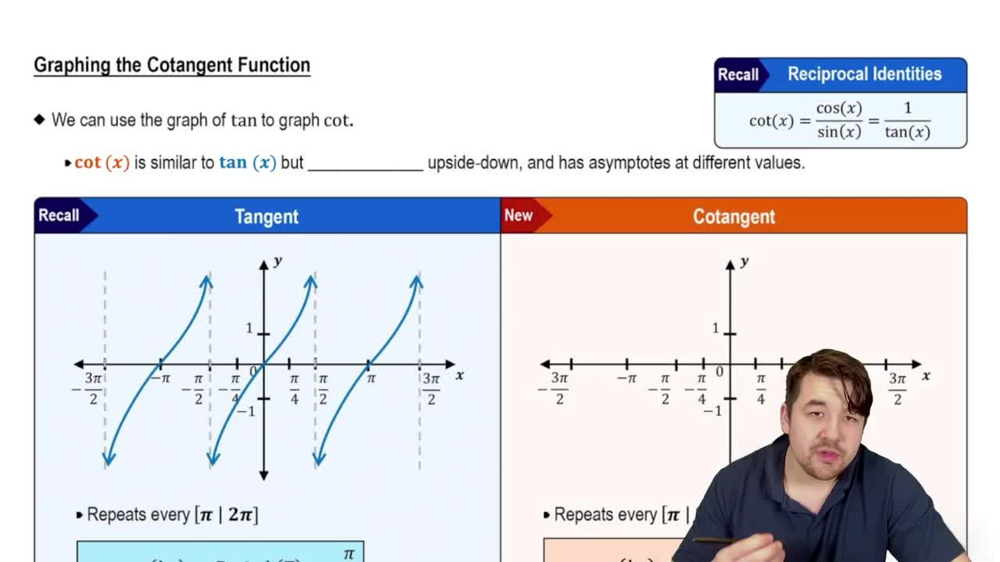
The cotangent function, cot(x), is the reciprocal of the tangent function and has vertical asymptotes where sin(x) = 0, i.e., at multiples of π. Its graph is periodic with period π, and it decreases from positive infinity to negative infinity between asymptotes. Understanding the shape and behavior of cot(x) is essential for identifying transformations.
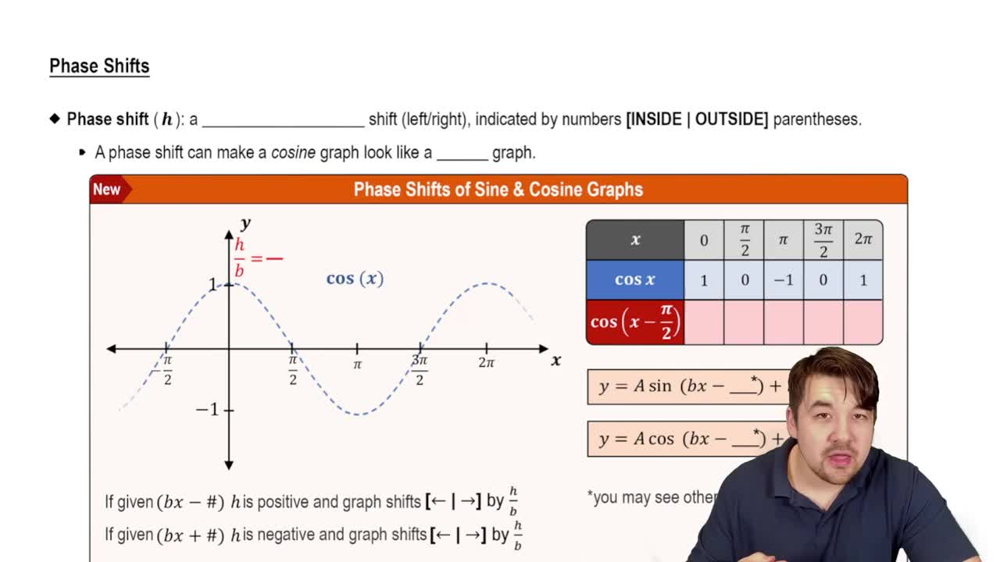
A phase shift in a trigonometric function like cot(x + c) shifts the graph horizontally by -c units. Positive inside the function shifts the graph to the left, and negative shifts it to the right. Recognizing how phase shifts affect the position of vertical asymptotes and zeros helps match the graph to its equation.
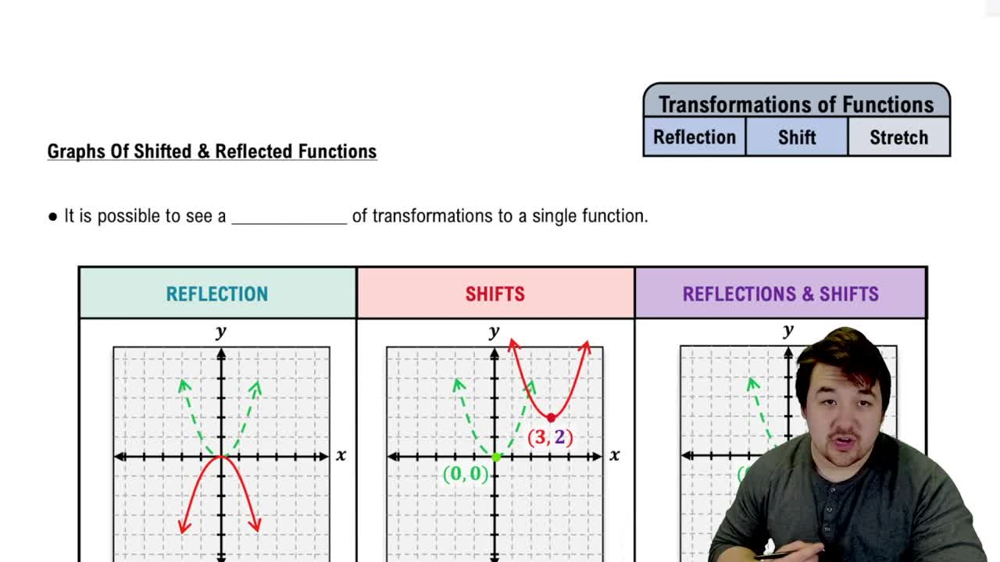
Multiplying cot(x) by -1 reflects the graph across the x-axis, reversing its increasing/decreasing behavior. This changes the sign of the function values but keeps the vertical asymptotes in the same place. Identifying reflections is key to distinguishing between equations like cot(x) and -cot(x).

 4:05 minutes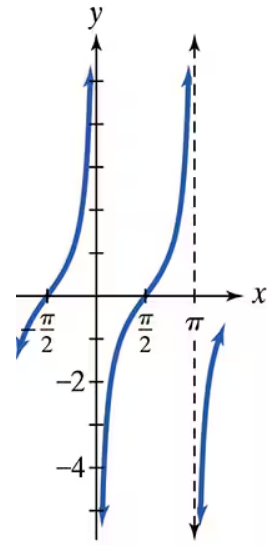
 Verified step by step guidance
 5:37
5:37