Ch. 5 - Trigonometric Identities
Lial - Trigonometry 12th Edition
Lial12th EditionTrigonometryISBN: 9780136552161Not the one you use?Change textbook
Chapter 6, Problem 5.RE.16

Work each problem.
Find the exact values of sin x, cos x, and tan x, for x = π/12 , using


a. difference identities


b. half-angle identities. 

Verified step by step guidance
1
Identify the angle \( x = \frac{\pi}{12} \) radians, which is equivalent to 15 degrees. Recognize that \( \frac{\pi}{12} = \frac{\pi}{3} - \frac{\pi}{4} \), so you can use difference identities with angles \( \frac{\pi}{3} \) and \( \frac{\pi}{4} \).
For part (a), apply the difference identities for sine, cosine, and tangent: - \( \sin(a - b) = \sin a \cos b - \cos a \sin b \) - \( \cos(a - b) = \cos a \cos b + \sin a \sin b \) - \( \tan(a - b) = \frac{\tan a - \tan b}{1 + \tan a \tan b} \) Use \( a = \frac{\pi}{3} \) and \( b = \frac{\pi}{4} \) and substitute the exact values of sine, cosine, and tangent for these standard angles.
For part (b), use the half-angle identities to find \( \sin \frac{\theta}{2} \), \( \cos \frac{\theta}{2} \), and \( \tan \frac{\theta}{2} \) where \( \theta = \frac{\pi}{6} \) because \( \frac{\pi}{12} = \frac{1}{2} \times \frac{\pi}{6} \). The half-angle formulas are: - \( \sin \frac{\theta}{2} = \pm \sqrt{\frac{1 - \cos \theta}{2}} \) - \( \cos \frac{\theta}{2} = \pm \sqrt{\frac{1 + \cos \theta}{2}} \) - \( \tan \frac{\theta}{2} = \pm \sqrt{\frac{1 - \cos \theta}{1 + \cos \theta}} \) or \( \tan \frac{\theta}{2} = \frac{\sin \theta}{1 + \cos \theta} \)
Determine the correct signs for the half-angle values based on the quadrant where \( x = \frac{\pi}{12} \) lies (first quadrant, so sine, cosine, and tangent are positive). Substitute the exact value of \( \cos \frac{\pi}{6} \) into the half-angle formulas.
Simplify the expressions under the square roots and the fractions to get the exact values of \( \sin \frac{\pi}{12} \), \( \cos \frac{\pi}{12} \), and \( \tan \frac{\pi}{12} \) using both methods, without calculating decimal approximations.

Verified video answer for a similar problem:

This video solution was recommended by our tutors as helpful for the problem above.
Was this helpful?

Key Concepts

Here are the essential concepts you must grasp in order to answer the question correctly.

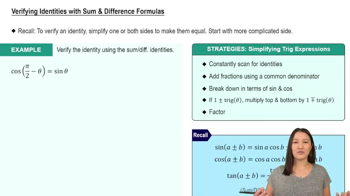
Difference Identities

Difference identities express the sine, cosine, or tangent of a difference of two angles in terms of the sines and cosines of the individual angles. For example, sin(a - b) = sin a cos b - cos a sin b. These identities allow exact evaluation of trigonometric functions for angles like π/12 by rewriting them as differences of known angles.
Recommended video:
2:25
Verifying Identities with Sum and Difference Formulas

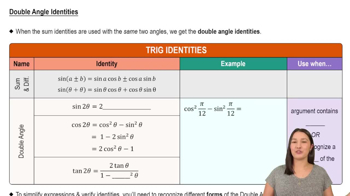
Half-Angle Identities

Half-angle identities provide formulas to find the sine, cosine, or tangent of half an angle using the cosine or sine of the original angle. For instance, sin(θ/2) = ±√((1 - cos θ)/2). These identities help compute exact trigonometric values for angles like π/12 by relating them to angles like π/6.
Recommended video:
05:06
Double Angle Identities

Exact Values of Common Angles

Knowing the exact sine, cosine, and tangent values of standard angles such as π/6, π/4, and π/3 is essential. These values serve as building blocks when applying difference or half-angle identities to find exact values for non-standard angles like π/12.
Recommended video:
3:47
Introduction to Common Polar Equations