Concept Check Does there exist an angle θ with the function values cos θ = ⅔ and sin θ = ¾?
Verified step by step guidance
1
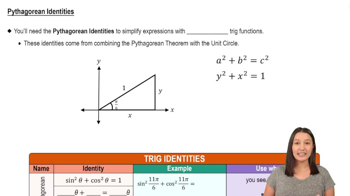
Recall the Pythagorean identity for sine and cosine: \(\sin^2 \theta + \cos^2 \theta = 1\).
Substitute the given values into the identity: \(\left(\frac{3}{4}\right)^2 + \left(\frac{2}{3}\right)^2\).
Calculate each square separately: \(\left(\frac{3}{4}\right)^2 = \frac{9}{16}\) and \(\left(\frac{2}{3}\right)^2 = \frac{4}{9}\).
Add the two fractions: \(\frac{9}{16} + \frac{4}{9}\), and find a common denominator to combine them.
Compare the sum to 1; if the sum equals 1, then such an angle \(\theta\) exists, otherwise it does not.
Verified video answer for a similar problem:
This video solution was recommended by our tutors as helpful for the problem above
Video duration:
3m
Play a video:
0 Comments
Key Concepts
Here are the essential concepts you must grasp in order to answer the question correctly.
Pythagorean Identity
The Pythagorean identity states that for any angle θ, the square of the sine plus the square of the cosine equals one: sin²θ + cos²θ = 1. This fundamental relationship helps verify if given sine and cosine values correspond to a valid angle.
Sine and cosine functions have values that always lie between -1 and 1 inclusive. Any value outside this range is not possible for these trigonometric functions, which is essential when checking the validity of given values.
Existence of an Angle Given Sine and Cosine Values
To determine if an angle θ exists with specific sine and cosine values, both values must satisfy the Pythagorean identity and lie within the valid range. If these conditions hold, such an angle exists; otherwise, it does not.

 3:50 minutes
 Verified step by step guidance
 6:25
6:25