Ch. 5 - Complex Numbers, Polar Coordinates and Parametric Equations
Blitzer - Trigonometry 3rd Edition
Blitzer3rd EditionTrigonometryISBN: 9780137316601Not the one you use?Change textbook
Chapter 5, Problem 5.1.49

In Exercises 37–52, perform the indicated operations and write the result in standard form.
√(−8) (√(−3) − √5 )

Verified step by step guidance
1
Recognize that the expression involves square roots of negative numbers, which means we are working with imaginary numbers. Recall that \(\sqrt{-a} = \sqrt{a} \cdot i\), where \(i\) is the imaginary unit with the property \(i^2 = -1\).
Rewrite each square root of a negative number in terms of \(i\): \(\sqrt{-8} = \sqrt{8} \cdot i\) and \(\sqrt{-3} = \sqrt{3} \cdot i\).
Substitute these into the expression: \(\sqrt{-8} (\sqrt{-3} - \sqrt{5}) = (\sqrt{8} \cdot i) \times (\sqrt{3} \cdot i - \sqrt{5})\).
Distribute \(\sqrt{8} \cdot i\) across the terms inside the parentheses: \(\sqrt{8} \cdot i \times \sqrt{3} \cdot i - \sqrt{8} \cdot i \times \sqrt{5}\).
Simplify each term: For the first term, multiply the square roots and \(i \times i = i^2 = -1\). For the second term, multiply the square roots and keep the \(i\). Then combine like terms to write the result in standard form \(a + bi\).

Verified video answer for a similar problem:

This video solution was recommended by our tutors as helpful for the problem above.
Video duration:
5m
Was this helpful?

Key Concepts

Here are the essential concepts you must grasp in order to answer the question correctly.

Complex Numbers and Imaginary Unit

Complex numbers include a real part and an imaginary part, where the imaginary unit i is defined as √−1. Expressions involving square roots of negative numbers can be rewritten using i, for example, √−8 = √8 × i = 2√2 i. Understanding this allows simplification of roots of negative numbers into complex form.
Recommended video:
3:31
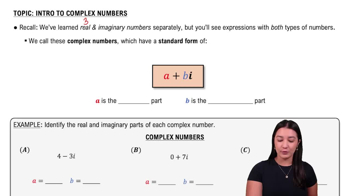
Introduction to Complex Numbers

Operations with Complex Numbers

Performing operations like multiplication and addition with complex numbers requires applying distributive property and combining like terms. When multiplying expressions involving i, remember that i² = −1, which helps convert powers of i into real numbers or simpler imaginary terms.
Recommended video:
4:22
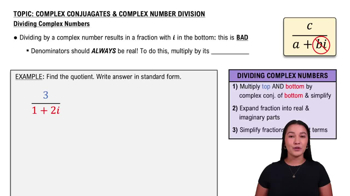
Dividing Complex Numbers

Standard Form of Complex Numbers

The standard form of a complex number is a + bi, where a and b are real numbers. After performing operations, the result should be expressed in this form by separating the real and imaginary parts clearly, facilitating easier interpretation and further calculations.
Recommended video:
04:47
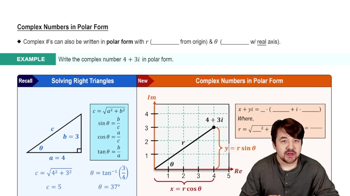
Complex Numbers In Polar Form