Ch. R - Algebra Review
Lial - Trigonometry 12th Edition
Lial12th EditionTrigonometryISBN: 9780136552161Not the one you use?Change textbook
Chapter 1, Problem 41

Add or subtract, as indicated. See Example 4. (6m⁴ - 3m² + m) - (2m³ + 5m² + 4m) + (m² - m)

Verified step by step guidance
1
First, rewrite the expression clearly by removing the parentheses, remembering to distribute the minus sign across the second group: \((6m^{4} - 3m^{2} + m) - (2m^{3} + 5m^{2} + 4m) + (m^{2} - m)\) becomes \$6m^{4} - 3m^{2} + m - 2m^{3} - 5m^{2} - 4m + m^{2} - m$.
Next, group like terms together. Like terms are terms that have the same variable raised to the same power. Grouping gives: \$6m^{4} + (-2m^{3}) + (-3m^{2} - 5m^{2} + m^{2}) + (m - 4m - m)$.
Now, combine the coefficients of each group of like terms by adding or subtracting them: For \(m^{4}\) terms: \$6m^{4}\(; for \)m^{3}\( terms: \)-2m^{3}\(; for \)m^{2}\( terms: \)-3 - 5 + 1\(; for \)m\( terms: \)1 - 4 - 1$.
Simplify each group by performing the arithmetic on the coefficients: Calculate the sum for \(m^{2}\) terms and for \(m\) terms separately.
Finally, write the simplified expression by combining all the simplified terms back together, maintaining the order from highest to lowest power.

Verified video answer for a similar problem:

This video solution was recommended by our tutors as helpful for the problem above.
Video duration:
5m
Was this helpful?

Key Concepts

Here are the essential concepts you must grasp in order to answer the question correctly.

Polynomial Addition and Subtraction

This involves combining like terms from different polynomials by adding or subtracting their coefficients. When subtracting, distribute the negative sign across all terms in the polynomial being subtracted before combining.
Recommended video:
3:18
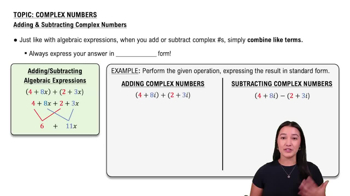
Adding and Subtracting Complex Numbers

Like Terms

Like terms are terms that have the same variable raised to the same power. Only like terms can be combined by adding or subtracting their coefficients to simplify the expression.
Recommended video:
5:02
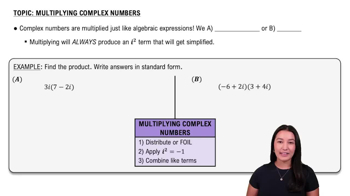
Multiplying Complex Numbers

Distributive Property

The distributive property allows you to multiply a single term across terms inside parentheses. It is essential when subtracting polynomials to correctly apply the negative sign to each term inside the parentheses.
Recommended video:
2:20
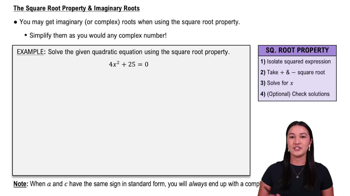
Imaginary Roots with the Square Root Property