
Textbook Question
Concept Check Find a solution for each equation. sin(4θ + 2°) csc(3θ + 5°) = 1
722
views

 Verified step by step guidance
 05:50
05:50
 04:46
04:46 6:36
6:36Concept Check Find a solution for each equation. sin(4θ + 2°) csc(3θ + 5°) = 1
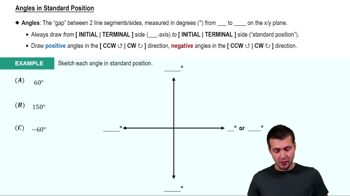
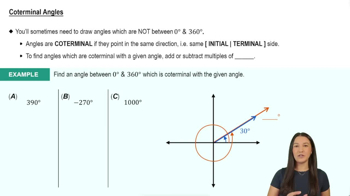
Concept Check Sketch each angle in standard position. Draw an arrow representing the correct amount of rotation. Find the measure of two other angles, one positive and one negative, that are coterminal with the given angle. Give the quadrant of each angle, if applicable. ―61 °
If n is an integer, n • 180° represents an integer multiple of 180°, (2n + 1) • 90° represents an odd integer multiple of 90° , and so on. Determine whether each expression is equal to 0, 1, or ―1, or is undefined. cos[n • 360°]
Concept Check Sketch each angle in standard position. Draw an arrow representing the correct amount of rotation. Find the measure of two other angles, one positive and one negative, that are coterminal with the given angle. Give the quadrant of each angle, if applicable. 300 °
Concept Check Sketch each angle in standard position. Draw an arrow representing the correct amount of rotation. Find the measure of two other angles, one positive and one negative, that are coterminal with the given angle. Give the quadrant of each angle, if applicable. 90 °
Concept Check Find a solution for each equation. sec(2θ + 6°) cos(5θ + 3°) = 1