In Exercises 43–52, determine the amplitude, period, and phase shift of each function. Then graph one period of the function. y = 3 cos(2x − π)
Table of contents
- 0. Review of College Algebra4h 45m
- 1. Measuring Angles40m
- 2. Trigonometric Functions on Right Triangles2h 5m
- 3. Unit Circle1h 19m
- 4. Graphing Trigonometric Functions1h 19m
- 5. Inverse Trigonometric Functions and Basic Trigonometric Equations1h 41m
- 6. Trigonometric Identities and More Equations2h 34m
- 7. Non-Right Triangles1h 38m
- 8. Vectors2h 25m
- 9. Polar Equations2h 5m
- 10. Parametric Equations1h 6m
- 11. Graphing Complex Numbers1h 7m
4. Graphing Trigonometric Functions
Graphs of the Sine and Cosine Functions
Problem 75
Textbook Question
In Exercises 75–78, graph one period of each function. y = |2 cos x/2|
Verified step by step guidance1
Identify the function to be graphed: \(y = |2 \cos \frac{x}{2}|\). Notice that the function involves the cosine of \(\frac{x}{2}\), scaled by 2, and then the absolute value is taken.
Determine the period of the inner cosine function. The standard cosine function \(\cos x\) has a period of \(2\pi\). Since the argument is \(\frac{x}{2}\), the period \(T\) is given by \(T = \frac{2\pi}{\frac{1}{2}} = 4\pi\).
Set the domain for one period of the function from \(x = 0\) to \(x = 4\pi\) to capture one full cycle of \(\cos \frac{x}{2}\).
Calculate key points within this interval where the cosine function reaches its maximum, minimum, and zeros. For example, find values of \(x\) where \(\cos \frac{x}{2} = 1, 0, -1\), then apply the transformations: multiply by 2 and take the absolute value.
Plot these points and sketch the graph by connecting them smoothly, remembering that the absolute value makes all negative values positive, so the graph will be reflected above the x-axis wherever \(2 \cos \frac{x}{2}\) is negative.
Verified video answer for a similar problem:This video solution was recommended by our tutors as helpful for the problem above
Video duration:
8mPlay a video:
0 Comments
Key Concepts
Here are the essential concepts you must grasp in order to answer the question correctly.
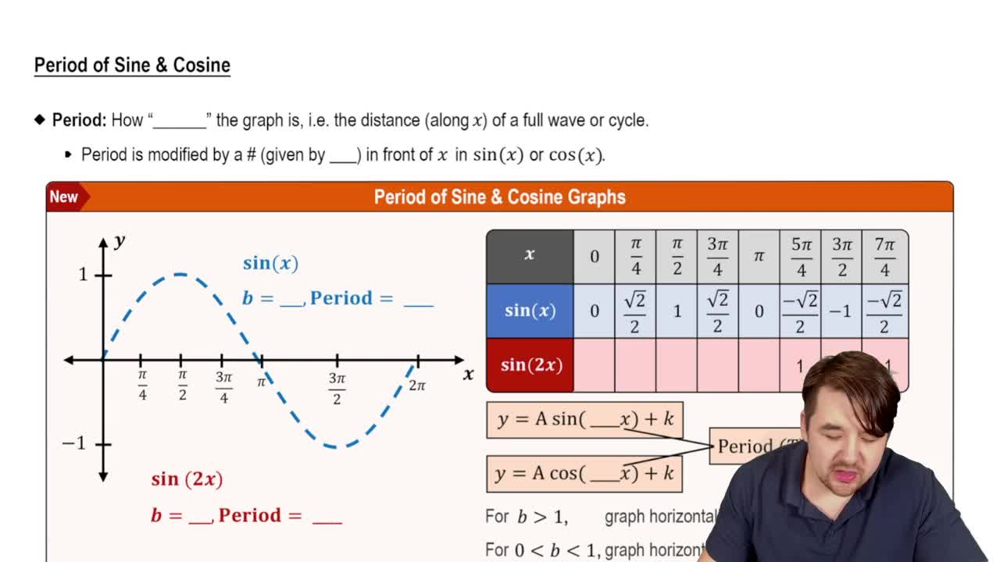
Period of a Trigonometric Function
The period of a trigonometric function is the length of the interval over which the function completes one full cycle before repeating. For functions like cosine, the standard period is 2π, but it changes when the function's argument is scaled, such as cos(bx), where the period becomes 2π/|b|.
Recommended video:
Period of Sine and Cosine Functions
Effect of Absolute Value on Trigonometric Graphs
Applying the absolute value to a trigonometric function, like y = |f(x)|, reflects all negative values of the function above the x-axis, making the entire graph non-negative. This transformation alters the shape by 'folding' the parts below the x-axis upward, affecting the graph's appearance but not its period.
Recommended video:
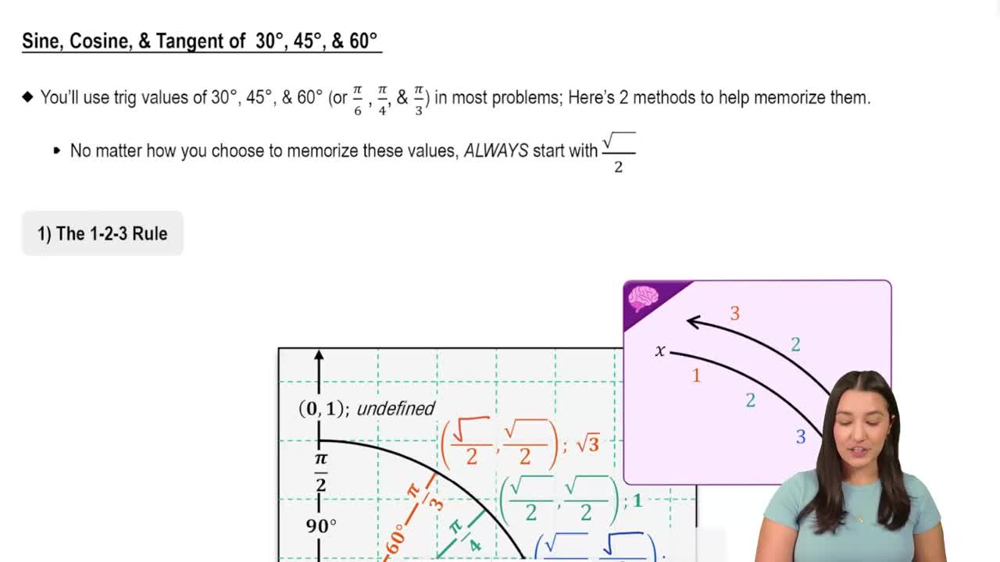
Sine, Cosine, & Tangent of 30°, 45°, & 60°
Graphing Scaled Trigonometric Functions
When the input of a trigonometric function is scaled, such as cos(x/2), the graph stretches horizontally, increasing the period. Understanding how the coefficient inside the function affects the x-axis scaling is essential for accurately plotting one period of the function.
Recommended video:
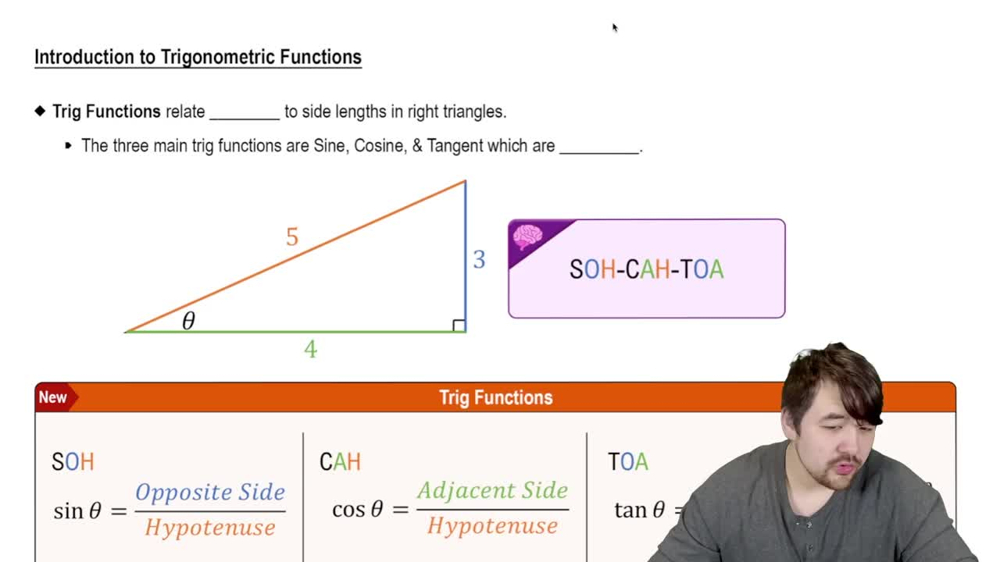
Introduction to Trigonometric Functions
Related Videos
Related Practice
Textbook Question
508
views