Ch. 3 - Trigonometric Identities and Equations
Blitzer - Trigonometry 3rd Edition
Blitzer3rd EditionTrigonometryISBN: 9780137316601Not the one you use?Change textbook
Chapter 3, Problem 67

In Exercises 54–67, solve each equation on the interval [0, 2𝝅). Use exact values where possible or give approximate solutions correct to four decimal places. 2 sin² x + sin x - 2 = 0

Verified step by step guidance
1
Recognize that the given equation is a quadratic in terms of \( \sin x \): \( 2 \sin^{2} x + \sin x - 2 = 0 \). To solve it, let \( y = \sin x \), so the equation becomes \( 2y^{2} + y - 2 = 0 \).
Use the quadratic formula to solve for \( y \): \( y = \frac{-b \pm \sqrt{b^{2} - 4ac}}{2a} \), where \( a = 2 \), \( b = 1 \), and \( c = -2 \).
Calculate the discriminant \( \Delta = b^{2} - 4ac = 1^{2} - 4 \times 2 \times (-2) \) and then find the two possible values for \( y = \sin x \).
For each value of \( y \), determine the corresponding values of \( x \) in the interval \( [0, 2\pi) \) by using the inverse sine function \( x = \arcsin(y) \) and considering the sine function's symmetry (i.e., solutions in the first and second quadrants for positive \( y \), and third and fourth quadrants for negative \( y \)).
Write down all solutions \( x \) in the interval \( [0, 2\pi) \) and express them either as exact values (in terms of \( \pi \)) or approximate decimal values rounded to four decimal places.

Verified video answer for a similar problem:

This video solution was recommended by our tutors as helpful for the problem above.
Video duration:
8m
Was this helpful?

Key Concepts

Here are the essential concepts you must grasp in order to answer the question correctly.

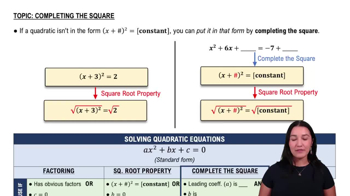
Solving Quadratic Equations in Trigonometric Form

This involves treating trigonometric expressions like sin²x as quadratic terms, allowing the use of algebraic methods such as factoring or the quadratic formula to find values of sin x. Recognizing the equation's quadratic form is essential to isolate sin x and solve for it.
Recommended video:
6:24
Solving Quadratic Equations by Completing the Square

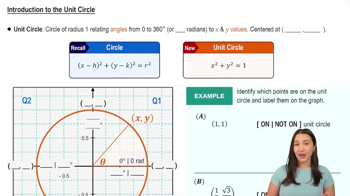
Unit Circle and Interval Restrictions

Solutions must lie within the interval [0, 2π), meaning all angles are measured in radians from 0 up to but not including 2π. Understanding the unit circle helps identify all possible angles where sin x takes the values found from the quadratic equation.
Recommended video:
06:11
Introduction to the Unit Circle

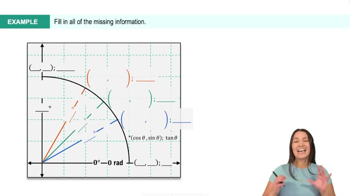
Exact Values and Approximate Solutions

When solving trigonometric equations, some solutions correspond to well-known exact values (like π/6 or π/2), while others require approximation. Being able to distinguish and compute both exact and approximate solutions (to four decimal places) is crucial for complete answers.
Recommended video:
6:04
Example 1