Ch. R - Algebra Review
Lial - Trigonometry 12th Edition
Lial12th EditionTrigonometryISBN: 9780136552161Not the one you use?Change textbook
Chapter 1, Problem 33a

Concept Check Plot each point, and then plot the points that are symmetric to the given point with point with respect to the (a) x-axis (5, -3)

Verified step by step guidance
1
Start by plotting the original point given, which is (5, -3). This means you move 5 units to the right along the x-axis and 3 units down along the y-axis.
To find the point symmetric to (5, -3) with respect to the x-axis, recall that reflecting a point over the x-axis changes the sign of the y-coordinate but keeps the x-coordinate the same.
Apply this reflection rule: the x-coordinate remains 5, and the y-coordinate changes from -3 to 3, giving the symmetric point (5, 3).
Plot the symmetric point (5, 3) on the coordinate plane by moving 5 units to the right and 3 units up from the origin.
Verify that the original point and its symmetric point are equidistant from the x-axis but on opposite sides, confirming the reflection is correct.

Verified video answer for a similar problem:

This video solution was recommended by our tutors as helpful for the problem above.
Video duration:
3m
Was this helpful?

Key Concepts

Here are the essential concepts you must grasp in order to answer the question correctly.

Coordinate Plane and Plotting Points

The coordinate plane is a two-dimensional surface defined by the x-axis (horizontal) and y-axis (vertical). Each point is represented by an ordered pair (x, y), where x indicates horizontal position and y indicates vertical position. Plotting a point involves locating its position based on these coordinates.
Recommended video:
06:17
Convert Points from Polar to Rectangular

Symmetry with Respect to the x-axis

Symmetry about the x-axis means reflecting a point across the x-axis. For a point (x, y), its symmetric point with respect to the x-axis is (x, -y). This flips the point vertically while keeping the horizontal position unchanged.
Recommended video:
3:19
Cardioids

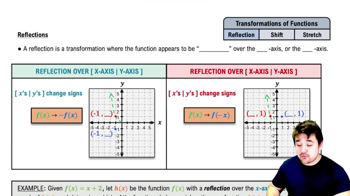
Reflection of Points

Reflection involves creating a mirror image of a point across a specific axis. In this case, reflecting across the x-axis changes the sign of the y-coordinate but leaves the x-coordinate the same. Understanding reflection helps in visualizing geometric transformations.
Recommended video:
5:00
Reflections of Functions