Ch. 6 - Inverse Circular Functions and Trigonometric Equations
Lial - Trigonometry 12th Edition
Lial12th EditionTrigonometryISBN: 9780136552161Not the one you use?Change textbook
Chapter 7, Problem 49

Use a calculator to approximate each value in decimal degrees.
θ = sin⁻¹ (-0.13349122)

Verified step by step guidance
1
Identify the problem: You need to find the angle \( \theta \) such that \( \sin(\theta) = -0.13349122 \), and express \( \theta \) in decimal degrees.
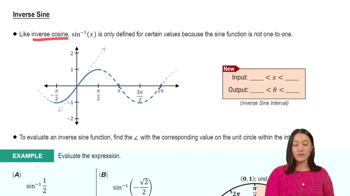
Recall the inverse sine function: \( \theta = \sin^{-1}(x) \) gives the angle whose sine is \( x \). The output of \( \sin^{-1} \) is usually in the range \( [-90^\circ, 90^\circ] \) when working in degrees.
Use a calculator set to degree mode to find the principal value: Input \( -0.13349122 \) into the inverse sine function \( \sin^{-1} \) to get the initial angle \( \theta_1 \).
Consider the sine function's symmetry: Since sine is negative, the angle \( \theta \) lies either in the third or fourth quadrant. The principal value from the calculator will be in the fourth quadrant (negative angle).
If needed, find the second possible angle by using the identity \( \theta_2 = 180^\circ - \theta_1 \) or by considering the unit circle, depending on the context of the problem.

Verified video answer for a similar problem:

This video solution was recommended by our tutors as helpful for the problem above.
Was this helpful?

Key Concepts

Here are the essential concepts you must grasp in order to answer the question correctly.

Inverse Sine Function (sin⁻¹ or arcsin)

The inverse sine function, denoted as sin⁻¹ or arcsin, returns the angle whose sine value is a given number. It is used to find an angle when the sine value is known, with the output typically restricted to the range of -90° to 90° (or -π/2 to π/2 radians).
Recommended video:
4:03
Inverse Sine

Domain and Range of the Sine and Inverse Sine Functions

The sine function outputs values between -1 and 1, so its inverse function only accepts inputs within this range. The inverse sine function’s output is limited to angles between -90° and 90°, ensuring a unique angle for each sine value.
Recommended video:
4:03
Inverse Sine

Using a Calculator to Find Decimal Degree Approximations

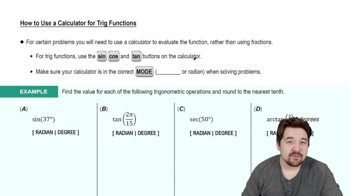
Calculators can compute inverse trigonometric functions and provide angle measures in degrees or radians. To approximate θ = sin⁻¹(-0.13349122), ensure the calculator is set to degree mode, input the value, and interpret the result as the angle in decimal degrees.
Recommended video:
4:45
How to Use a Calculator for Trig Functions